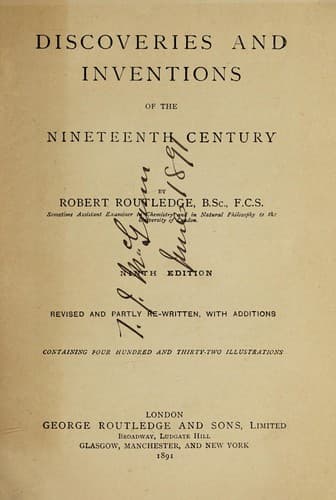
Discoveries and Inventions of the Nineteenth CenturyRoutledge, Robert
History
Discoveries and Inventions of the Nineteenth Century
Routledge, Robert
Inventions -- History -- 19th century
If the reader will cast his eye on the map of the United States, he will
see towards the northern boundary a great fresh-water system, comprising
five enormous lakes, the least of which is nearly two hundred, and the
largest nearly three hundred miles in length, in all presenting a total
area greater by far than that of England and Scotland together thrice
told. This lake system has a line of coast to be reckoned only by
thousands of miles, and for a long time an enormous traffic has been
carried across its waters by sailing vessels of all kinds, two- or
three-masted schooners, brigs, and other craft, carrying wood, stone,
lime, and other commodities. On the map, the position of the Detroit
River, which leads from the southern extremity of Lake Huron to Lake
Erie, will readily be recognised, and this strait, which is in the only
line of transport from the three great upper lakes, formerly presented
all the picturesqueness that crowds of boats of every build could
impart. Especially was this the case at Amherstburg, its southern
extremity, where sometimes a northern wind would make the passage
impracticable for several days in succession, and a fleet of a hundred
or two hundred sailing vessels would collect to await the opportunity of
a favouring breeze in order to carry them against the current to Port
Huron. Then, taking advantage of the right moment, they would set their
sails, and in a compact body move slowly up the strait. This was not
quick enough to meet the traffic, and, before long, larger vessels were
built, which were towed up and down the Detroit by steam-tugs. The next
step of replacing sailing ships by steam-vessels was not long in
following, and though there still exist fine specimens of sailing craft
on the lakes, their day may be said to be over. The navigation of these
lakes, before the extensive development of the railway systems near
their shores, comprised a large passenger traffic, which was carried on
by big paddle-wheel steamers, and at the time of the great westward set
of emigration to Michigan, Wisconsin, and Minnesota, these steamers were
crowded to their utmost capacity. The great improvement which in recent
years has become possible for passenger steamers in speed, cabin
accommodation, and other particulars, above all, the growth of great
cities on the shores, the progress of the territories adjoining the lake
system, and other circumstances, are now combining to renew the
passenger traffic on a larger scale than ever. “Fifteen millions of
people,” says Mr. H. A. Griffin, the Secretary of the Cleveland Board of
Control (_Engineering Magazine_, iv., 819), “now live upon the shore
lines of the lakes, or within six hours’ travel by rail, and nearly all
of that population is south of the United States boundary line. The
territory directly tributary to the lakes, north and south of the line,
is capable of easily maintaining a population of 100,000,000.... It does
Public-domain text, read in full here on John Shaqi.
Reviews
Reviews
No reviews yet
Be the first to share your thoughts on this work.
Elsewhere in the archive
Join the Discussion
Join the discussion
Sign in to leave a comment or review.
Sign InorCreate an account