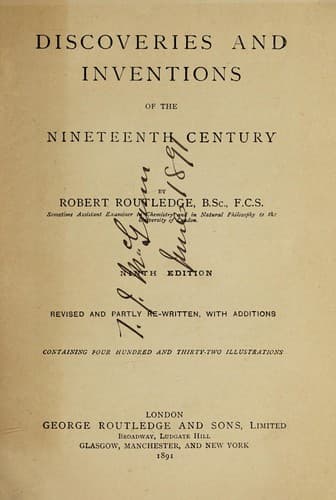
Discoveries and Inventions of the Nineteenth CenturyRoutledge, Robert
History
Discoveries and Inventions of the Nineteenth Century
Routledge, Robert
Inventions -- History -- 19th century
The paddle-wheels were of a primitive form, and as they were unprovided
with paddle-boxes, the arrangement had the appearance of a great
undershot mill-wheel on each side of the boat, above the deck of which
was placed the steam-engine, a position it has retained in all these
river-boats, in which a huge, rhombus-shaped beam, oscillating high
above the deck, is a conspicuous feature. Another boat of much larger
dimensions was built the following year, having a tonnage of nearly 300,
and from that time there has been a more or less regular increase in the
sizes of the vessels, until in 1866 a tonnage of nearly 3,000 was
reached. In 1817 a vessel called the _Livingstone_ was launched, which
was able to go up to Albany in eighteen hours. In 1823 was launched the
_James Kent_, a novel feature in which vessel was the boiler made of
copper, and weighing upwards of 30 tons. It was so planned that if it
happened to burst, the hot water would be carried through the bottom of
the vessel by tubes or hollow pillars. From this it appears that
considerable apprehension existed as to the liability of the boilers
exploding. We are told that the cost of the copper boiler was in this
case nearly one-third of that of the whole vessel. The cabins are
described as having been very handsomely fitted up, and the speed was
such that fourteen hours sufficed for the trip up river to Albany. Many
fine boats were placed on the river during the twenty following years,
and these were marked by various improvements, as when, in 1840,
anthracite coal was for the first time substituted for wood as the fuel
for the furnaces, with the effect of reducing the cost of this item to
one-half. Then, in 1844, iron began to be used for constructing the
hulls, and a few years afterwards, steamers having a speed of twenty
miles an hour and over, became quite common. In 1865, and again in the
eighties, some four screw-propeller boats were built; but this type does
not appear to have found much favour on the Hudson, for the large
paddle-wheels and the single or double beam, working high above the
deck, have continued the almost universal form of construction. A very
popular and famous boat was placed on the Hudson in 1861. This was the
_Mary Powell_, called the “Queen of the Hudson,” which, although a boat
of moderate tonnage (983), was able on occasion to steam at the rate of
twenty-five miles an hour. This vessel was placed on the line between
New York and Rondont, and was still running in 1894.
Public-domain text, read in full here on John Shaqi.
Reviews
Reviews
No reviews yet
Be the first to share your thoughts on this work.
Elsewhere in the archive
Join the Discussion
Join the discussion
Sign in to leave a comment or review.
Sign InorCreate an account