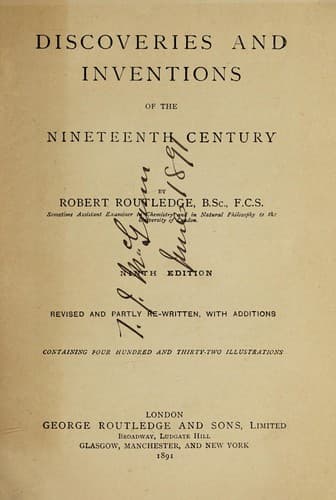
Discoveries and Inventions of the Nineteenth CenturyRoutledge, Robert
History
Discoveries and Inventions of the Nineteenth Century
Routledge, Robert
Inventions -- History -- 19th century
One of the most modern and most elegant boats on the Hudson is the _New
York_, launched in 1887, and declared by Mr. Stanton to be one of the
finest river steam-boats in the world, well arranged, and beautifully
finished and furnished. She is built on fine lines, is 311 feet long, 40
feet broad, and with a tonnage of 1,552, draws only 12¼ feet of water.
She can steam at twenty miles an hour, and is placed on one of the New
York and Albany lines. Throughout the summer there are both day and
night boats for Albany, and the latter especially are of great size,
three stories high, and provided with saloons, state-rooms, and, in
fact, all the accommodation of a luxurious first-class hotel. The
vessels named in this notice include but a few of the splendid boats
that ply on the River Hudson, and, in respect of their numbers, speed,
and comfort, it may safely be asserted that they cannot be equalled on
any other river in the world.
[Illustration:
PLATE X.
THE “NEW YORK.”
]
[Illustration:
FIG. 69.—_H.M.S. Devastation in Queenstown Harbour._
]
SHIPS OF WAR.
“Take it all in all, a ship of the line is the most honourable thing
that man, as a gregarious animal, has ever produced. By himself,
unhelped, he can do better things than ships of the line; he can make
poems, and pictures, and other such concentrations of what is best in
him. But as a being living in flocks, and hammering out with alternate
strokes and mutual agreement, what is necessary for him in those flocks
to get or produce, the ship of the line is his first work. Into that he
has put as much of his human patience, common sense, forethought,
experimental philosophy, self-control, habits of order and obedience,
thoroughly wrought hand-work, defiance of brute elements, careless
courage, careful patriotism, and calm expectation of the judgment of
God, as can well be put into a space of 300 ft. long by 80 ft. broad.
And I am thankful to have lived in an age when I could see this thing so
done.” So wrote Mr. Ruskin about forty years ago, referring, of course,
to the old wooden line-of-battle ships. It may be doubted whether he
would have written thus enthusiastically about so unpicturesque an
object as the _Glatton_, just as it may be doubted whether the
armour-plated steamers will attain the same celebrity in romance and in
verse as the old frigates with their “wooden walls.” Certain it is that
the patience, forethought, experimental philosophy, thoroughly wrought
hand-work, careful patriotism, and other good qualities which Mr. Ruskin
saw in the wooden frigates, are not the less displayed in the new
ironclads.
Public-domain text, read in full here on John Shaqi.
Reviews
Reviews
No reviews yet
Be the first to share your thoughts on this work.
Elsewhere in the archive
Join the Discussion
Join the discussion
Sign in to leave a comment or review.
Sign InorCreate an account