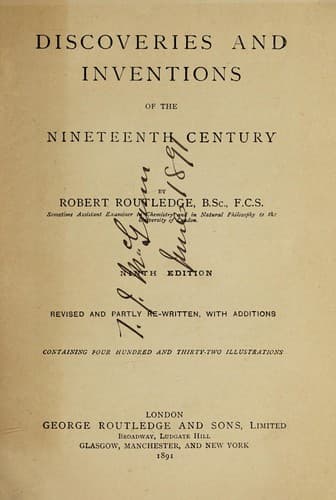
Discoveries and Inventions of the Nineteenth CenturyRoutledge, Robert
History
Discoveries and Inventions of the Nineteenth Century
Routledge, Robert
Inventions -- History -- 19th century
The invention of gunpowder—or rather its use in war—appears at first
sight a device little calculated to promote the general progress of
mankind. But it has been pointed out by some historians that the
introduction of gunpowder into Europe brought about the downfall of the
feudal system with its attendant evils. In those days every man was
practically a soldier: the bow or the sword he inherited from his father
made him ready for the fray. But when cannons, muskets, and mines began
to be used, the art of war became more difficult. The simple possession
of arms did not render men soldiers, but a long special training was
required. The greater cost of the new arms also contributed to change
the arrangements of society. Standing armies were established, and war
became the calling of only a small part of the inhabitants of a country,
while the majority were left free to devote themselves to civil
employments. Then the useful arts of life received more attention,
inventions were multiplied, commerce began to be considered as
honourable an avocation as war, letters were cultivated, and other
foundations laid for modern science. If such have really been the
indirect results of the invention of gunpowder, we shall hardly share
the regret of the fine gentleman in “Henry IV.”:
“That it was great pity, so it was,
That villanous saltpetre should be digged
Out of the bowels of the harmless earth,
Which many a good tall fellow had destroyed
So cowardly.”
We often hear people regretting that so much attention and ingenuity as
are shown by the weapons of the present day should have been expended
upon implements of destruction. It would not perhaps be difficult to
show that if we must have wars, the more effective the implements of
destruction, the shorter and more decisive will be the struggles, and
the less the total loss of life, though occurring in a shorter time.
Then, again, the exasperated and savage feelings evoked by the
hand-to-hand fighting under the old system have less opportunity for
their exercise in modern warfare, which more resembles a game of skill.
But the wise and the good have in all ages looked forward to a time when
sword and spear shall be everywhere finally superseded by the
ploughshare and the reaping-hook, and the whole human race shall dwell
together in amity. Until that happy time arrives—
“Till the war-drum throbs no longer, and the battle flags are furl’d
In the Parliament of man, the Federation of the world—
When the common sense of most shall hold a fretful realm in awe,
And the kindly earth shall slumber, lapt in universal law,”—
Public-domain text, read in full here on John Shaqi.
Reviews
Reviews
No reviews yet
Be the first to share your thoughts on this work.
Elsewhere in the archive
Join the Discussion
Join the discussion
Sign in to leave a comment or review.
Sign InorCreate an account