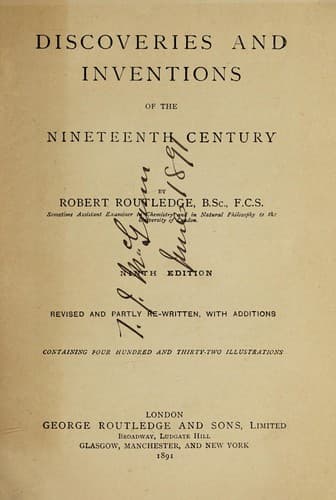
Discoveries and Inventions of the Nineteenth CenturyRoutledge, Robert
History
Discoveries and Inventions of the Nineteenth Century
Routledge, Robert
Inventions -- History -- 19th century
As much will have to be said about _rifling_ the bores of muskets and
cannon, we may here explain the nature and object of this device. The
projectiles used in all guns down to comparatively recent times were
almost invariably of spherical form, and could indeed scarcely be
otherwise with smooth-bore weapons. As the diameter of the shot would
necessarily be something less than that of the bore of the barrel, a
considerable loss of power would result from the escape of the powder
gases between the shot and the barrel, which escape is known as
_windage_. Another disadvantage of the spherical projectile is that for
the same weight of metal the air offers a greater resistance to its
passage, and consequently checks its speed more quickly than that of any
other circular form; for the air resistance is proportional to the
square of the diameter, and therefore if we take a ball of 1 in.
diameter and a cylinder of 1 in. in length, each having the same weight
of metal, the diameter of the cylindrical shot will be a little more
than four-fifths of an inch, and the air resistance to the ball will be
exactly half as much again as to the cylinder, that is, in the
proportion of 3 to 2. Again, the passage of the spherical shot within
the barrel of the gun will not be in a straight line, but in a series of
rebounds from side to side, and its direction on leaving the muzzle will
depend upon which part of the bore it just before impinges on, as from
that it will also take a rotatory “twist” that will in part determine
its path through the air.
Public-domain text, read in full here on John Shaqi.
Reviews
Reviews
No reviews yet
Be the first to share your thoughts on this work.
Elsewhere in the archive
Join the Discussion
Join the discussion
Sign in to leave a comment or review.
Sign InorCreate an account