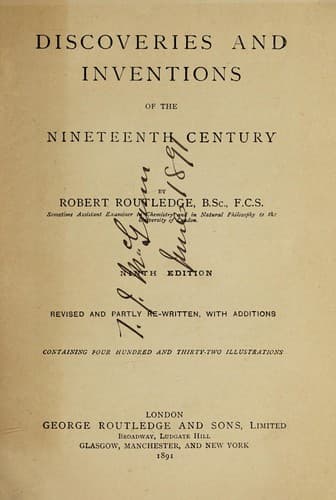
Discoveries and Inventions of the Nineteenth CenturyRoutledge, Robert
History
Discoveries and Inventions of the Nineteenth Century
Routledge, Robert
Inventions -- History -- 19th century
Now if an elongated projectile were fired from a smooth-bore gun, its
course through the air would be erratic to a degree impossible to the
spherical shot, for it would turn end over end with deviations that
would make aiming impracticable. But if the elongated projectile is made
to spin rapidly enough about its longitudinal axis, it flies through the
air quite steadily, the axis of rotation remaining parallel to that of
the gun throughout the whole flight. The steadiness due to rapid
rotation has familiar examples in spinning tops, in gyroscopic tops, in
the way arrows are feathered so that the air may cause them to revolve
axially, and so on. The axial rotation of the projectile is effected by
ploughing out in the cylindrical barrel of the gun a number of spiral or
twisting grooves, which the projectile is compelled to follow as it
travels along the barrel, either by means of corresponding protuberances
formed upon its surface in the first instance, as in Jacob’s bullets, or
by studs let into it, as in the studded shots and shells for ordnance
which constituted at one time the regulation plan adopted by the British
Government; or otherwise by making the force of the explosion expand
some portion of the projectile in such a manner that this portion shall
completely fill up the grooves, thus preventing windage, and causing the
projectile to follow the twist of the grooves. This is the more general
method, especially since the adoption of breech-loading. The Lancaster
rifling, and that advocated by Whitworth, are the same in principle, but
differ in appearance, from the section of the barrel being made in the
one case oval, in the other hexagonal or polygonal, but with the twist
necessary to produce rotation.
Public-domain text, read in full here on John Shaqi.
Reviews
Reviews
No reviews yet
Be the first to share your thoughts on this work.
Elsewhere in the archive
Join the Discussion
Join the discussion
Sign in to leave a comment or review.
Sign InorCreate an account