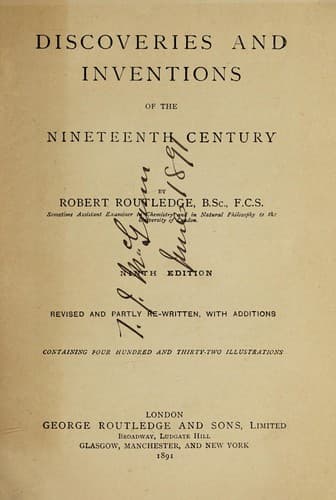
Discoveries and Inventions of the Nineteenth CenturyRoutledge, Robert
History
Discoveries and Inventions of the Nineteenth Century
Routledge, Robert
Inventions -- History -- 19th century
Incident to the discharge of all fire-arms, great and small, is a
phenomenon of which we have to speak, because it is one which in the
mounting of heavy ordnance especially has to be taken into account. And
as it also illustrates in a very direct way one of the most general laws
of nature, while people often have very vague and erroneous ideas of its
cause and operation, it deserves the reader’s attention. In gunnery it
is called the _recoil_, and is familiar to anyone who has ever fired a
pistol, fowling-piece, or rifle, in the kick backwards felt at the
moment of the discharge. This law is in operation whenever the condition
of a body in respect to its rest or motion is changing. That is,
whenever a body at rest has motion given to, or if when already moving
it is made to go faster or slower, or to stop, or when the direction of
the motion is changed from that in a straight line. Now although these
changes or actions are frequently occurring before our eyes, the
operation in them of Newton’s third law of motion does not generally
present itself to common observation. This third law was stated by Sir
Isaac Newton thus:—“To every action there is always an opposite and
equal reaction.” Now the expanding gases due to the gunpowder explosion
press the bullet forwards and the barrel (with its attachments)
backwards, with the same pressure in both cases, but at the end of the
bullet’s passage along the bore the same velocity is not imparted to the
two bodies, because the same pressure acting for the same time on bodies
of unequal _mass_ always produces velocities that are inversely
proportional to the _masses_. The reader should try to acquire this
conception of _mass_, remarking that it is a something quite distinct
from that of _weight_. A given lump of metal, for instance, would have
exactly the same _mass_ in any part of the universe, whereas its weight
would depend upon its position; as, for instance, at the distance from
the earth of the moon’s orbit, it would _weigh_ only as 1/3600th part of
its weight at the earth’s surface, and if it could be carried to the
very centre of the earth it would there have no weight at all. Though
the lump of metal will have different weights at different parts of the
earth’s surface, it has been found (by experiment) that the weights of
bodies at any one place are proportional to their masses. Therefore the
same numbers that express the weights of bodies might also express their
masses; but for certain good reasons these quantities are referred to
different units. In England a piece of metal weighing 32 lbs. under
standard conditions is said to have mass = 1; and so on. As with the
_same pressure acting for the same time_, the velocities imparted are
inversely proportional to the masses, it follows that the number
expressing the velocity multiplied by that representing the mass in each
such case of action and reaction will give the same product, or in other
Public-domain text, read in full here on John Shaqi.
Reviews
Reviews
No reviews yet
Be the first to share your thoughts on this work.
Elsewhere in the archive
Join the Discussion
Join the discussion
Sign in to leave a comment or review.
Sign InorCreate an account