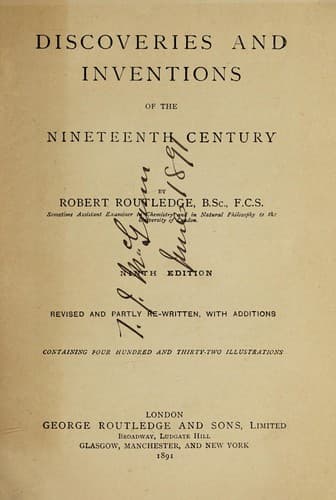
Discoveries and Inventions of the Nineteenth CenturyRoutledge, Robert
History
Discoveries and Inventions of the Nineteenth Century
Routledge, Robert
Inventions -- History -- 19th century
The foregoing presupposes that the air offers no resistance to the
passage of the projectile through it. The fact however is quite
otherwise, for no sooner does the projectile begin its flight than its
velocity is constantly diminished by the air’s resistance. Now this
resistance is complex, depending upon a number of different conditions,
the effect of which can be taken into account only by extremely complex
calculations. Obviously it will vary according to the area of the
section presented by the projectile to the line of its flight, and again
by the shape of its front, for a pointed shot will cleave the air with
less resistance than one with a flat front. Then the density of the air
at the time will also enter into the calculation. The mass of the
projectile and also its velocity, upon which depend its _vis viva_,
energy, or power of overcoming resistance in doing work, will also have
to be considered. Most complex of all is the law, or rather laws (_i.e._
relations), which connect the air resistance with the velocity; for this
relation no definite expression has been found. It is a function of the
velocity (known only by experiment under defined conditions), and
varying with the velocity itself. Thus for velocities up to 790 ft. per
second, it is a function (determined experimentally) of the second power
or square of the velocity; between 790 ft. per second and 990 ft. per
second the law of resistance is changed and becomes a function of the
third power of the velocity; between 990 ft. and 1,120 ft. velocity the
law again changes and is related to the sixth power of the velocity;
between 1,120 ft. and 1,330 ft. the resistance is again related to the
third power of the velocity; and with higher speeds than that last named
it is again more nearly related to the square of the velocity. It will
be seen that to calculate the path of a projectile is really a very
difficult mathematical problem, and indeed one which can be solved only
approximately when all the known data are supplied.
The air resistance to the motion of a projectile is much greater than
before trial would be supposed. Let us take an experiment that has
actually been recorded, in which a bullet three-quarters of an inch in
diameter, weighing one-twelfth of a pound, was found to have a velocity
of 1,670 ft. per second at a distance of 25 ft. from the gun, and this
50 ft. farther was reduced to 1,550 ft. per second. Now if the reader
will calculate, according to the formula we have given above, the
_energy_ due to the bullet’s velocity at these points, he will find it
must have done 500 foot-lbs. units of work in traversing the 50 ft., and
as this could have been expended only in overcoming the resistance of
the air, we learn that this last must have been equivalent to a mean or
average pressure of 10 lbs. thrusting the bullet backwards.
Public-domain text, read in full here on John Shaqi.
Reviews
Reviews
No reviews yet
Be the first to share your thoughts on this work.
Elsewhere in the archive
Join the Discussion
Join the discussion
Sign in to leave a comment or review.
Sign InorCreate an account