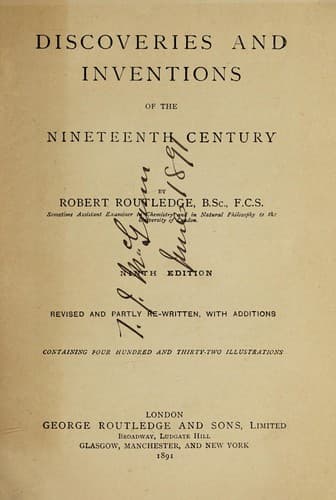
Discoveries and Inventions of the Nineteenth CenturyRoutledge, Robert
History
Discoveries and Inventions of the Nineteenth Century
Routledge, Robert
Inventions -- History -- 19th century
It will be interesting to compare the difference in the trajectory of a
projectile under defined conditions, worked out with the air resistance
taken into account, compared with the trajectory when the air is
supposed to be non-existent. We find an example of the former problem
fully worked out by many elaborate mathematical formulæ in Messrs. Lloyd
and Hadcock’s treatise on Artillery. The problem is thus stated:—“An
11–in. breech-loading howitzer” (a howitzer is a piece of ordnance used
for firing at high angles) “fires a 600–lb. projectile with an initial
velocity of 1,120 foot-sec. at an elevation of 20°. Find the range, time
of flight, and angle of descent.” We shall calculate these points on the
suppositions adopted with regard to Fig. 80, and with no higher
mathematics than common multiplication and division.
It will have been observed that we supposed two motions that really take
place simultaneously to take place successively and independently: one
in the direction of the line of fire, due to the initial velocity; the
other vertically downwards, due to the action of gravity, the final
result being the same. This affords an excellent illustration of another
of Newton’s laws of motion, and should be considered by the reader in
this connection. The law itself admits of being stated in various ways,
as thus:—“Whenever a force acts on a body, it produces upon it exactly
the same change of motion in its own direction, whether the body be
originally at rest or in motion in any direction with any velocity
whatever—whether it be at the same time acted on by other forces or
not.” Or again: “When two forces act in any direction whatever on a body
free to move, they impress upon it a motion which is the _superposition_
(or compounding) of those that it would receive if each force acted
separately.” The law is given also in the following form (Thomson and
Tait):—“When any forces act on a body, then, whether the body be
originally at rest or moving with any velocity and in any direction,
each force produces in the body the exact change of motion which it
would have had had it acted singly on the body originally at rest.” In
all of these expressions the word “forces” is used, and a very
convenient word it is, but it may be noted in passing, nothing but a
word; for it stands for no real self-existing things, since, apart from
observed changes of motion in bodies, forces for us have no existence.
Nevertheless, it is useful for the sake of abbreviating statements about
changes of motion, to regard these actions as produced by imaginary
agents—imagined for the time and for this purpose, and therefore vainly
to be sought for in the realm of reality.
[Illustration:
FIG. 81.—_Diagram._
]
Public-domain text, read in full here on John Shaqi.
Reviews
Reviews
No reviews yet
Be the first to share your thoughts on this work.
Elsewhere in the archive
Join the Discussion
Join the discussion
Sign in to leave a comment or review.
Sign InorCreate an account