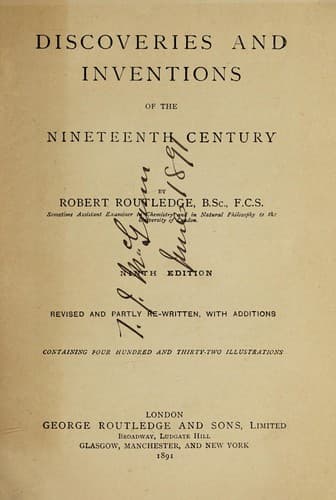
Discoveries and Inventions of the Nineteenth CenturyRoutledge, Robert
History
Discoveries and Inventions of the Nineteenth Century
Routledge, Robert
Inventions -- History -- 19th century
mechanism for holding the magazine in reserve while the rifle is used as
a single loader. As to calibre, the Austrian authorities follow other
countries in adopting a small bore, namely, 0·315 inch. Italy has
converted her single-fire Vetterli rifle into a magazine arm, with a box
something like the Mannlicher, and Belgium has adopted a gun of the same
type. The rate of fire from charged magazines of such guns as the “Lee,”
“Mannlicher” and “Vetterli,” worked with the right hand without bringing
the piece down from the shoulder is, for all of them, about one shot per
second; but the time that is required to recharge the magazines varies
much according to the contrivance used. The number of rounds the
magazine of a rifle is capable of containing when fully charged is from
5 to 12, or more, according to the difference of system. It is
considered that in the detachable Lee or the quick recharging Mannlicher
five rounds are ample for use at a critical moment.
[Illustration:
FIG. 89.—_The Magazine and Breech of the Mannlicher Rifle._
]
The calibre of the military rifle has been decreased with almost every
new pattern adopted. Thus, while the _old_ “Brown Bess” had a calibre of
0·75 inch, in the last issue of it the bore was reduced to 0·693 inch;
the Enfield (1852) had a bore of 0·577 inch; the Martini-Henry, 0·451
inch, which, in a newer pattern adopted in 1887, was reduced to 0·400
inch; and, finally, in the Lee-Metford, the calibre is only 0·303 inch.
A similar consecutive reduction of bores has taken place in the rifles
adopted by other countries, and one of the latest type, issued for the
use of the United States Navy, has a bore of only 0·236 inch, and it is
even expected that a still smaller one will become general. The
advantage of the narrow and lighter projectile is that while it has a
higher initial velocity with a given charge, its flight is less checked
by the resistance of the atmosphere, the section it presents being so
much less. Thus the bullet of 0·236 inch diameter has a section little
more than one-fourth that of the 0·45 inch bullet. The difference is
well shown in the comparative heights of the _trajectory_ (or path of
the bullet) of the Martini-Henry 0·450 inch bullet, and that of the
0·303 inch Lee-Metford (the latter with _cordite_ ammunition); for at a
range of 1,000 yards the former reaches to 48 feet above the line of
sight, while the latter rises to only 25 feet.
Public-domain text, read in full here on John Shaqi.
Reviews
Reviews
No reviews yet
Be the first to share your thoughts on this work.
Elsewhere in the archive
Join the Discussion
Join the discussion
Sign in to leave a comment or review.
Sign InorCreate an account