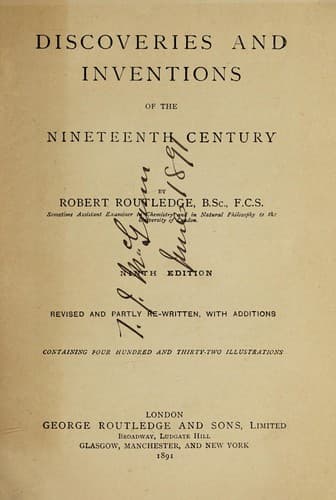
Discoveries and Inventions of the Nineteenth CenturyRoutledge, Robert
History
Discoveries and Inventions of the Nineteenth Century
Routledge, Robert
Inventions -- History -- 19th century
Some form of repeating or magazine rifle has now been adopted by all the
most important nations of the world. The number of shots contained in
the magazines varies from 5 to 12. In the British detachable box
magazine there are ten charges. The calibres of the barrels range in the
infantry patterns of different nations from 0·256 inch to 0·315 inch;
the explosive used in every case is some kind of smokeless powder, and
this, in the cartridge for the Lee-Metford, is _cordite_. The bullets
are not made simply of lead, but of lead coated with a harder metal or
alloy such as steel, cupro-nickel, nickel steel, or they consist
entirely of some of these alloys.
Although the magazine rifle is now the regulation weapon of the infantry
of all great armies, it is not improbable that at no distant future it
maybe superseded by one in which, as in certain machine guns, the force
of the recoil will be used for actuating the breech and lock movements.
Many patents have already been taken out for rifles on this principle,
and several patterns have actually been constructed, in which a merely
momentary contact of the breech-piece with the end of the barrel is
sufficient; the recoil of the barrel with the reaction of a spring
performs all the requisite movements with such rapidity that an amazing
speed of firing has been obtained. It is said that such an automatic gun
can send forth bullets at a perfectly amazing rate. Of course the
mechanism of such a gun is somewhat intricate, and it is impossible to
explain its construction and action without a great number of diagrams
and much description.
_RIFLED CANNON._
Having briefly sketched in the foregoing section the development of the
military rifle from such weapons as our own “Brown Bess,” down to the
repeating or magazine rifle, we now purpose to adopt a similar course
with regard to ordnance, giving also some particulars of the methods of
manufacture, etc., and following in general the order of history.
Public-domain text, read in full here on John Shaqi.
Reviews
Reviews
No reviews yet
Be the first to share your thoughts on this work.
Elsewhere in the archive
Join the Discussion
Join the discussion
Sign in to leave a comment or review.
Sign InorCreate an account