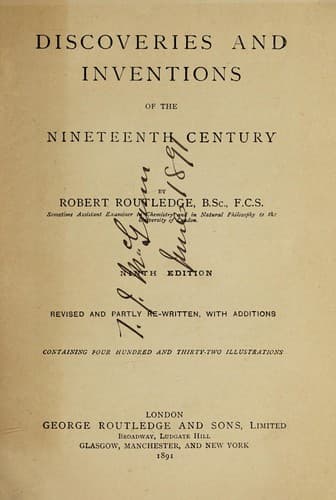
Discoveries and Inventions of the Nineteenth CenturyRoutledge, Robert
History
Discoveries and Inventions of the Nineteenth Century
Routledge, Robert
Inventions -- History -- 19th century
The B tube, like certain other portions of these guns, is constructed
from coiled iron bars, and this constitutes one great peculiarity of Sir
W. Armstrong’s system. It has the immense advantage of disposing the
metal so that its fibres encircle the piece, thus applying the strength
of the iron in the most effective way. The bars from which the coils are
prepared are made from “scrap” iron, such as old nails, horse-shoes, &c.
A pile of such fragments, built up on a wooden framework, is placed in a
furnace and intensely heated. When withdrawn the scraps have by
semi-fusion become coherent, and under the steam hammer are soon welded
into a compact mass of wrought iron, roughly shaped as a square prism.
The glowing mass is now introduced into the rolling-mill, and in a few
minutes it is rolled out, as if it were so much dough, into a long bar
of iron. In order to form this into a coil it is placed in a very long
furnace, where it can be heated its entire length. When sufficiently
heated, one end of the bar is seized and attached to an iron core of the
required diameter, and the core being made to revolve by a steam engine,
the bar is drawn out of the furnace, winding round the core in a close
spiral, so that the turns are in contact. The coil is again intensely
heated, and in this condition a few strokes of the steam hammer in the
direction of its axis suffice to combine the spires of the coil into one
mass, thus forming a hollow cylinder.
The B tube for the 9 in. gun is formed of two double coils. When the two
portions have been completely welded together under the steam hammer,
the tube, after cooling, is roughly turned and bored. It is again fine
bored to the required diameter, and a register of the diameter every few
inches down the bore is made. These measurements are taken for the
purpose of adapting most accurately the dimensions of the steel barrel
to the bore of the B tube, as it is found that perfect exactness is more
easily obtained in turning than in boring. The steel barrel is therefore
again turned to a size slightly _larger_ than the bore of the B tube,
and is then placed muzzle end upwards, and so arranged that a stream of
water, to keep it cool, shall pass into it and out again at the muzzle,
by means of a syphon, while the B tube, which has been heated until it
is sufficiently expanded, is passed over it and gradually cooled.
If now the B tube were allowed to cool spontaneously, its ends would, by
cooling more rapidly than the central part, contract upon the steel
barrel and grip it firmly at points which the subsequent cooling would
tend to draw nearer together longitudinally, and thus the barrel would
be subjected to injurious strains. In order to prevent this, the B tube
is made to cool progressively from the breech end, by means of jets of
water made to fall upon it, and gradually raised towards the muzzle end,
which has in the meanwhile been prevented from shrinking by having
circles of gas-flames playing upon it.
Public-domain text, read in full here on John Shaqi.
Reviews
Reviews
No reviews yet
Be the first to share your thoughts on this work.
Elsewhere in the archive
Join the Discussion
Join the discussion
Sign in to leave a comment or review.
Sign InorCreate an account