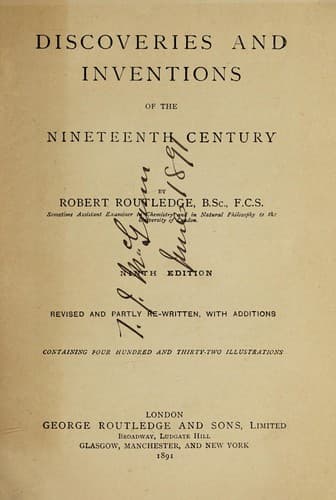
Discoveries and Inventions of the Nineteenth CenturyRoutledge, Robert
History
Discoveries and Inventions of the Nineteenth Century
Routledge, Robert
Inventions -- History -- 19th century
The portion of the gun, consisting of the steel barrel with the B tube
shrunk on it, having been placed upright with the muzzle downwards, the
breech-piece, strongly heated, is brought over it by a travelling crane,
and slips over the steel barrel, while the recess in it receives the end
of the B tube. Cold water is forced up into the inside of the barrel in
order to keep it cool. As the breech cools, which it is allowed to do
spontaneously, it contracts and grips the barrel and B tube with great
force. The cascable requires to be very carefully fitted. It is this
piece which plays so important a part in resisting the force tending to
blow out the end of the barrel. The cascable is a solid screw formed of
the very best iron, and its inner end is wrought by scraping and filing,
so that when screwed in there may be perfect contact between its face
and the end of the steel barrel. A small annular space is left at the
circumference of the inner end, communicating through a small opening
with the outside. The object of this is, that in case of rupture of the
steel barrel, the gases escaping through it may give timely warning of
the state of the piece.
Besides minor operations, there remain the important processes of
finishing the boring, and of rifling. The boring is effected in two
operations, and after that the interior is gauged in every part, and
“lapping” is resorted to where required, in order to obtain the perfect
form. Lapping consists in wearing down the steel by friction against
fine emery powder and oil, spread on a leaden surface. The piece is then
ready for rifling. The machinery by which the rifling is performed
cannot be surpassed for its admirable ingenuity and simplicity.
In this operation the gun is fixed horizontally, its axis coinciding
with that of the bar, which carries the grooving tools. This bar is
capable of two independent movements, one backwards and forwards in a
straight line in the direction of the length of the bar, and the other a
rotation round its axis. The former is communicated by a screw parallel
to the bar, and working in a nut attached to the end of it. For the
rotatory movement the bar carries a pinion, which is engaged by a rack
placed horizontally and perpendicularly to the bar, and partaking of its
backward and forward movement, but arranged so that its end must move
along another bar placed at an angle with the former. It is this angle
which determines the pitch of the rifling, and by substituting a curved
guide-bar for the straight one, an increasing twist may be obtained in
the grooves.
Public-domain text, read in full here on John Shaqi.
Reviews
Reviews
No reviews yet
Be the first to share your thoughts on this work.
Elsewhere in the archive
Join the Discussion
Join the discussion
Sign in to leave a comment or review.
Sign InorCreate an account