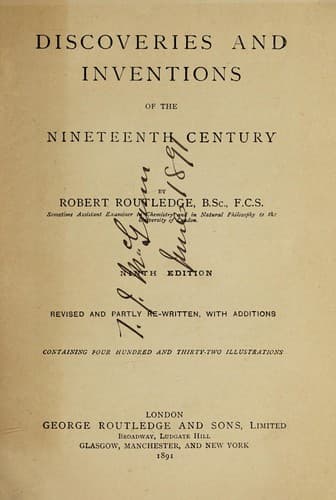
Discoveries and Inventions of the Nineteenth CenturyRoutledge, Robert
History
Discoveries and Inventions of the Nineteenth Century
Routledge, Robert
Inventions -- History -- 19th century
office, leaves a nearly empty space before the piston, in which it
advances with little or no resistance. On the rod which works the
air-pump, two pins are placed, so as to move the lever, H, up and down
through a certain space, when one pin is near its highest and the other
near its lowest position, and thus the valves are opened and closed when
the piston reaches the termination of its stroke. In the condenser, I, a
stream of cold water is constantly playing, the flow being regulated by
the handle, _f_. The steam, in condensing, heats the cold water, adding
to its bulk, and at the same time the air, which is always contained in
water, is disengaged, owing to the heat and the reduced pressure. Hence
it is necessary to pump out both the air and the water by the pump, J,
which is worked by the beam of the engine. In his engines Watt adopted
the heavy fly-wheel, which tends to equalize the movement, and render
insensible the effects of those variations in the driving power and in
the resistance which always occur. In the action of the engine itself
there are two positions of the piston, namely, where it is changing its
direction, in which there is no force whatever communicated to the
piston-rod by the steam. These positions are known as the “dead points,”
and in a rotatory engine occur twice in each revolution. The resistance
also is liable to great variations. Suppose, for example, that the
engine is employed to move the shears by which thick plates of iron are
cut. When a plate has been cut, the resistance is removed, and the speed
of the engine increases; but this increase, instead of taking place by a
sudden start, takes place gradually, the power of the engine being in
the meantime absorbed in imparting increased velocity to the fly-wheel.
When another plate is put between the shears, the power which the
fly-wheel has gathered up is given out in the slight diminution of its
speed occasioned by the increased resistance. But for the fly-wheel,
such changes of velocity would take place with great suddenness, and the
shocks and strains thereby caused would soon injure the machine. This
expedient, in conjunction with that admirable contrivance, the
“governor,” renders it possible to set the same engine at one moment to
forge an anchor, and at the next to shape a needle. One of the most
ingenious of Watt’s improvements is what is termed the “parallel
motion,” consisting of a system of jointed rods connecting the head of
the piston-rod, R, with the end of the oscillating beam. As, during the
motion of the engine, the former moves in a straight line, while the
latter describes a circle, it would be impossible to connect them
directly. Watt accomplished this by hinging rods together in form of a
parallelogram, in such a manner that, while three of the angles describe
circles, the fourth moves in nearly a straight line. Watt was himself
surprised at the regularity of the action. “When I saw it work for the
Public-domain text, read in full here on John Shaqi.
Reviews
Reviews
No reviews yet
Be the first to share your thoughts on this work.
Join the Discussion
Join the discussion
Sign in to leave a comment or review.
Sign InorCreate an account