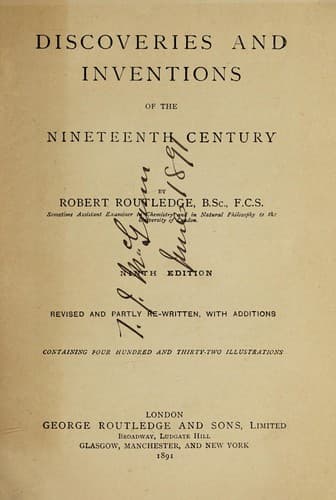
Discoveries and Inventions of the Nineteenth CenturyRoutledge, Robert
History
Discoveries and Inventions of the Nineteenth Century
Routledge, Robert
Inventions -- History -- 19th century
_c_{1}_, _c_{2}_, _c_{3}_ and _b_{1}_, _b_{2 3}_; and if they can be put
at some distance, the position of the torpedo is determined with great
accuracy by the intersection of the lines of sight of the two
telescopes. Electric wires connect the stations and the torpedoes in the
same manner as we have before described. Such methods of firing
torpedoes are no doubt the most efficient, for the destructive charge
may be sunk so far below the surface that not a ripple or an eddy can
excite an enemy’s suspicion, or the channel appear otherwise than free
and unobstructed, while friendly ships may pass and repass without risk;
for the current which determines the explosion only passes when the two
sentinels complete the circuit by simultaneously depressing their keys.
Attempts have often been made to convert the torpedo into an offensive
weapon, by causing vessels containing explosive charges to drift by
currents, or otherwise, into contact with the enemy’s ships. The results
have been always unsatisfactory, as there is great uncertainty of the
machine coming into contact with its intended mark. Besides, it is easy
to defend vessels against such attacks by placing nets, &c., to
intercept the hostile visitors, especially if the attack is made by day,
and by night the chance that a torpedo drifting at random would strike
its object is very small indeed. One condition essential to the success
of such attacks is that the approach of the insidious antagonist may be
unobserved. Accordingly divers schemes have been projected for
propelling vessels wholly submerged beneath the surface of the water, so
that they may approach their object unperceived, and exert their
destructive effect precisely at that part of the vessel where damage is
most fatal, and where an ironclad vessel is most vulnerable, namely,
below the water-line. Vessels have been built, propelled by steam and so
contrived that their bodies are wholly submerged, only the funnel being
visible above the surface. These _quasi_ submarine ships carry small
crews, and are fitted with a long projecting spar in front, at the end
of which is carried the torpedo.
[Illustration:
FIG. 109.—_Explosion of Whitehead’s Torpedo._
]
[Illustration:
FIG. 110.—_Effect of the Explosion of Whitehead’s Torpedo._
]
Public-domain text, read in full here on John Shaqi.
Reviews
Reviews
No reviews yet
Be the first to share your thoughts on this work.
Elsewhere in the archive
Join the Discussion
Join the discussion
Sign in to leave a comment or review.
Sign InorCreate an account