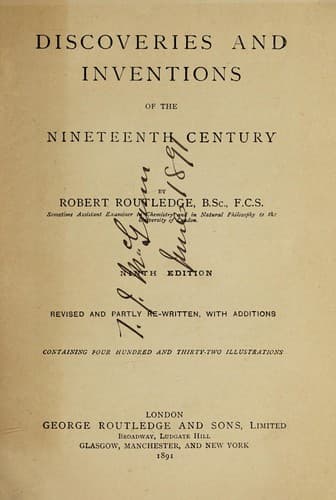
Discoveries and Inventions of the Nineteenth CenturyRoutledge, Robert
History
Discoveries and Inventions of the Nineteenth Century
Routledge, Robert
Inventions -- History -- 19th century
The Federal navy sustained several disasters from torpedo-boats of this
kind. For example, the commander of the United States steamer
_Housatonic_ reported the loss of that vessel by a rebel torpedo off
Charleston on the evening of the 17th February, 1864, stating that about
8·45 p.m. the officer of the deck discovered something in the water
about 100 yards from, and moving towards, his ship. It had the
appearance of a plank moving in the water. It came directly towards the
ship, the time from when it was first seen till it was close alongside
being about two minutes; and hardly had it arrived close to the ship
before it exploded, and the ship began to sink. The torpedo-boat, with
its commander and crew, were lost, having, it is supposed, gone into the
hole made by the explosion, and sunk with the _Housatonic_. In general,
however, the performance of submarine boats has been unsatisfactory.
There is the difficulty of determining accurately the course of the
boat; there is great danger to the men manning it, as exemplified in the
case above; and there is again the problem of providing a means of
propulsion which shall enable such a boat to advance or retreat for,
say, a mile or more, without making its presence conspicuous by smoke or
otherwise. The latter condition would appear to exclude the use of steam
for such purposes, as the inevitable smoke and vapour would betray the
presence of the wily craft. Another power which has been proposed is air
strongly compressed, and recently a still more portable agent has been
suggested in solid carbonic acid, which is capable of exerting a
pressure of forty atmospheres by passing into the gaseous form. A
locomotive form of torpedo, invented by Mr. Whitehead, has the explosive
charge, which consists of about 18 lbs. of glyoxyline, placed in the
front part of a cigar-shaped vessel, the other part containing mechanism
for working a screw-propeller, by means of compressed air contained in a
suitable reservoir. This torpedo having been sunk a few feet below the
water, the motive power may be set in action by drawing a cord attached
to a detent, when the mechanical fish proceeds in a straight line under
the water. It is said that this torpedo is effective at 500 yards from
the ship attacked, and may even be made sufficiently powerful to travel
1,000 yards under the water. The great objection to such arrangements is
the uncertainty of the missile arriving at its destination, for even
supposing that the water were without currents, the least deviation from
the straight course would cause the torpedo to pass wide of the mark at
1,000 yards distant. It is said that at the experimental trials more
than one projector of such war engines has been startled by his machine,
after pursuing a circuitous submarine course, exploding in dangerous
proximity to the place whence it was sent off, the engineer narrowly
escaping being “hoist with his own petard.” The experiments which have
Public-domain text, read in full here on John Shaqi.
Reviews
Reviews
No reviews yet
Be the first to share your thoughts on this work.
Elsewhere in the archive
Join the Discussion
Join the discussion
Sign in to leave a comment or review.
Sign InorCreate an account