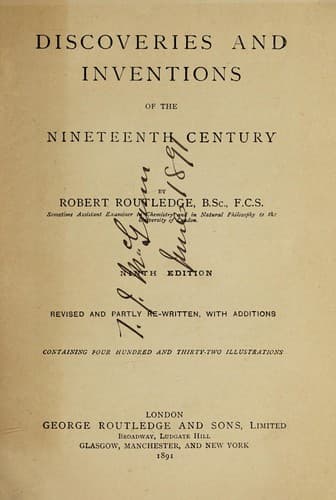
Discoveries and Inventions of the Nineteenth CenturyRoutledge, Robert
History
Discoveries and Inventions of the Nineteenth Century
Routledge, Robert
Inventions -- History -- 19th century
Another device for submarine attacks upon vessels on which much
ingenuity has been expended is the submarine gun. It has been sought to
propel missiles beneath the surface of the water, these missiles being
usually provided with a charge which, on contact with the vessel’s side,
would explode, and by making a hole below the water-line, cause the
certain destruction of the ship. It is obvious that such a mode of
attack would reach the only vulnerable parts of a thickly-plated
ironclad, and therefore the project has been recently revived in several
forms. Fig. 120 is taken from the photograph of a model of an invention
of this kind. The guns which are to propel the submarine projectiles,
have port-holes formed by valves in such a manner that the gun when
loaded can be run out without allowing water to enter; it can then be
fired while the muzzle is below the surface, and again drawn in without
the port being at any time so opened that water can pour into the
vessel. All contrivances of this kind have hitherto been failures;
indeed, it does not appear possible that they could succeed, except at
very close quarters, for the resistance offered by water to a body
moving rapidly in it is extremely great, and, as we have already had
occasion to state, the resistance increases as the square of the
velocity, and probably in even a higher degree for very great
velocities. Any one who will remember the effort it requires to move
one’s hand quickly backwards and forwards through water will easily
understand that the resistance it presents would, in a comparatively
short space, check the speed of a projectile, however great that speed
might be at first. A good many years ago Mr. Warner produced a great
sensation by an invention which appears to have been essentially a
floating torpedo. The cut below, Fig. 121, represents the result of an
experiment publicly made by him off Brighton, in 1844, upon a barque,
which was towed out by a steamer to a distance of a mile and a half from
the shore. Mr. Warner was on board the steamer, and the barque was 300
yards astern. Five minutes after a signal had been made from the shore,
the torpedo was caused to explode, striking the barque amidships,
throwing up a large column of water and _débris_, shooting the mainmast
clean out of the vessel, the mizen going by the board, and dividing the
hull into two parts, so that she sank immediately. Yet this invention,
though apparently so successful, does not seem to have ever been put in
practice.
[Illustration:
FIG. 121.—_The Warner Experiment off Brighton._
]
Public-domain text, read in full here on John Shaqi.
Reviews
Reviews
No reviews yet
Be the first to share your thoughts on this work.
Elsewhere in the archive
Join the Discussion
Join the discussion
Sign in to leave a comment or review.
Sign InorCreate an account