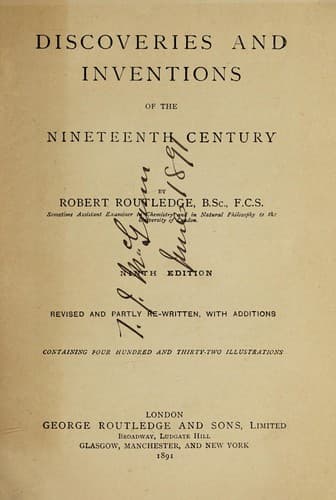
Discoveries and Inventions of the Nineteenth CenturyRoutledge, Robert
History
Discoveries and Inventions of the Nineteenth Century
Routledge, Robert
Inventions -- History -- 19th century
The stationary torpedoes of the kind mostly used in the American Civil
War were, as already stated, _self-acting_; that is, they exploded when
touched by a passing vessel. They would now be more generally called
_self-acting mines_, and are to be distinguished from that form of the
weapon in which the explosion is determined by some manipulation on
shore, such as the closing of an electric circuit, when the hostile
vessel comes within the area of destructive action. This form receives
the name of _observation mines_. Stationary mines are essentially
instruments of defence, and as such are employed for the protection of
rivers and harbours. The self-acting varieties usually contain a charge
of 70 lbs. to 80 lbs. of gun-cotton, and are commonly arranged in lines.
Of course, when the occasion for which such mines have been laid down is
past, they must be removed, and the operation of picking them up is one
of great danger. The observation mines, on the other hand, do not
require immediate removal, and they can be taken up with little risk. In
the British service the observation mine contains about 500 lbs. of
gun-cotton, and a line of these is sometimes moored in a water-way, from
35 feet to 50 feet below the surface. The area of destructive action in
this case is a circle of about 30 feet radius, and therefore a line of
seven such mines laid across a channel at intervals of 120 feet apart
would ensure the almost certain destruction of any war vessel of
ordinary breadth that might attempt to pass up a river of 840 feet in
width. This is about the distance across the Thames near the Tower of
London, but the depth of the river there being only 12 feet at low-water
and 33 feet at high-water, would not suffice to give effect to the full
energy of so large a charge of gun-cotton; for it has been found that,
for a given charge, there is a certain depth under water at which its
explosion will produce the maximum effect, and this depth will be
greater with heavier charges than with light ones. The regulation
“observation mine” of the British service has a cylindrical case of
stout plate-iron, 32 inches in diameter and 34 inches high, with domed
ends. Within this gun-cotton is contained, in a wet condition, in a
number of copper envelopes, which have holes for access of water to wet
the charge from time to time as occasion requires, the wet condition
being the safest for the carriage of gun-cotton. The centre of the case
is a tin charged with some discs of dry gun-cotton, and the detonator
required to bring about the explosion of the whole charge when the
electrical contact is made, fires the fuze contained within the primer.
These cases are arranged to have a certain buoyancy, and are moored with
wire ropes to heavy iron sinkers, the mooring ropes being of such length
as to keep the explosive case at the proper depth below the surface, and
of sufficient strength to resist the force of the currents in the
waterway.
Public-domain text, read in full here on John Shaqi.
Reviews
Reviews
No reviews yet
Be the first to share your thoughts on this work.
Elsewhere in the archive
Join the Discussion
Join the discussion
Sign in to leave a comment or review.
Sign InorCreate an account