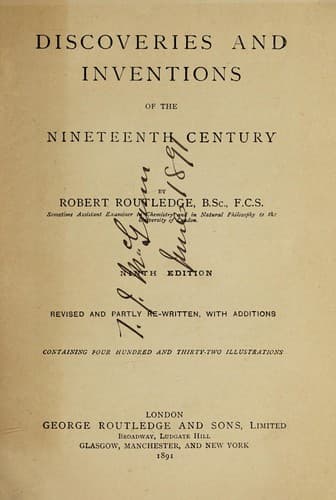
Discoveries and Inventions of the Nineteenth CenturyRoutledge, Robert
History
Discoveries and Inventions of the Nineteenth Century
Routledge, Robert
Inventions -- History -- 19th century
patterns can now show a speed of 30 knots or more. The committee
appointed by the Admiralty to conduct experiments with the first pair of
torpedoes brought to England, after having tested them in various ways
for a period extending over six months, reported that they believed that
“any maritime nation failing to provide itself with submarine locomotive
torpedoes, would be neglecting a great source of power, both for offence
and defence.” Upon this recommendation the Admiralty immediately
purchased from Mr. Whitehead for £15,000 the secret of the internal
mechanism of his invention and the rights of manufacturing it. The
self-adjusting apparatus within the steering chamber, by means of which
the torpedo was kept at its due depth, was then a jealously-guarded
secret; but when the arrangement with Mr. Whitehead was effected, the
Government immediately set about the manufacture of these torpedoes on a
large scale. The artificers employed in making the Whitehead torpedoes
were now numerous, and the internal structure of these weapons could not
advantageously be altogether concealed from those who had to handle them
on board of the ships, so that it inevitably happened that some details
of their construction leaked out, and came into the possession of other
powers, whereupon all the maritime states followed the example of Great
Britain by providing their navies with Whitehead or some such form of
locomotive torpedo. It is no part of our plan to enter into the
mechanical _minutiæ_ of the Whitehead torpedo. We may, however, give the
reader such an idea of the external appearance and internal arrangement
of the Whitehead torpedo as will enable him to appreciate to some extent
the ingenuity and skill that have been brought to bear upon its
construction.
Public-domain text, read in full here on John Shaqi.
Reviews
Reviews
No reviews yet
Be the first to share your thoughts on this work.
Elsewhere in the archive
Join the Discussion
Join the discussion
Sign in to leave a comment or review.
Sign InorCreate an account