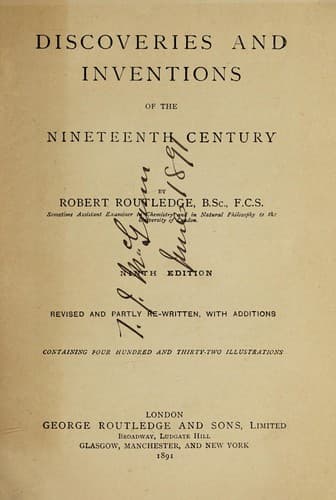
Discoveries and Inventions of the Nineteenth CenturyRoutledge, Robert
History
Discoveries and Inventions of the Nineteenth Century
Routledge, Robert
Inventions -- History -- 19th century
There are in existence many different patterns of the
weapon—twenty-four, it is said—and this is what might be expected from
the fact of its being produced at several different manufactories, each
striving to effect whatever improvements its resources will supply. Some
torpedoes have been made at Fiume, very many at Mr. Whitehead’s works at
Portland, as also at the Government establishment at Woolwich, while
private enterprise in this direction is encouraged by contracts with
some private firms, such as that of Messrs. Greenwood & Bately at Leeds.
The greatest diameter of the large torpedo is 18 inches, but in some it
is rather more, in others 14 inches or 16 inches; and the length may
vary between 14 feet and 19 feet. Many of our Whitehead torpedoes are
made of polished steel, but in the later patterns phosphor-bronze is
partly made use of, as being not liable to corrode. The interior of the
torpedo is divided by transverse partitions into five distinct
compartments. The foremost of these, called the “head,” contains the
explosive charge when the weapon is ready for use in actual warfare.
This section, which may occupy about one-sixth of the total length, is
an air-tight case made of phosphor-bronze, one-sixteenth of an inch
thick, and it is kept permanently charged with slabs of wet gun-cotton,
which may amount to 200 pounds weight in all, and is ready to be
attached by a screw and bayonet joint to the body of the torpedo; but
this is done only at the time immediately before it is required for its
destructive employment. Its place at other times, as when the torpedo is
used for drill practice, and to test its running powers, is occupied by
a dummy head of steel, of exactly the same shape and size, and packed
with wood in such a manner that its weight and centre of gravity are
like those of the explosive head when the latter is ready for action.
The wet gun-cotton requires a _detonative_ explosive of dry material
close to it, in order to determine its own detonation. The explosive
heads of the Whitehead are not fitted with the pistol and priming tube
until all is ready for the discharge of the weapon, as this would render
the handling of the torpedo highly dangerous. This priming apparatus is
merely a metallic tube that slips into a corresponding hollow in the
explosive head so far as to reach well within the wet gun-cotton charge,
although still separated from the latter by a metal casing. The
posterior extremity of the priming tube contains a few ounces of dry
gun-cotton, and just in front of this is a copper cap containing some
fulminate of mercury, which readily explodes when struck by the point of
a steel rod, occupying the centre of the tube and projecting a short
distance out at the “nose” of the torpedo, so as to be driven inwards by
the impact of the latter on a ship’s side. The explosion of the
fulminate causes the detonation of the dry gun-cotton at the bottom of
the priming tube, and this is taken up by the whole mass of the
Public-domain text, read in full here on John Shaqi.
Reviews
Reviews
No reviews yet
Be the first to share your thoughts on this work.
Elsewhere in the archive
Join the Discussion
Join the discussion
Sign in to leave a comment or review.
Sign InorCreate an account