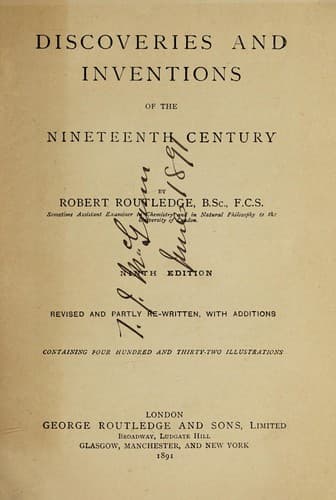
Discoveries and Inventions of the Nineteenth CenturyRoutledge, Robert
History
Discoveries and Inventions of the Nineteenth Century
Routledge, Robert
Inventions -- History -- 19th century
Artificial canals are amongst the oldest of inventions, for, centuries
ago, they have been constructed, even of very large dimensions, in
various parts of the world. There is in China, for instance, a great
canal, 900 miles in length and 200 feet broad, which is supposed to have
been made 800 years ago. The advantages of canals did not escape the
attention of the Egyptians, Greeks and Romans. We read of very early
attempts to cut through isthmuses, in order to form a water
communication between regions where other carriage would be long and
difficult. It appears to be admitted that canals connecting the Red Sea
with the Mediterranean existed some centuries before the Christian era,
and to cut the Isthmus of Corinth by a waterway was a cherished project
with several Roman Emperors, and now it appears that in this nineteenth
century this project will shortly be realized. But as the canal-lock is
but a comparatively modern invention, dating only from the fourteenth
century, and first used in Holland, all the canals anterior to that
period had to be designed as level cuts, a restriction which greatly
increased the difficulties of the problem. Canals were in use in various
parts of Europe, particularly in Holland and France, long before any
were constructed in England, as, for example, the Languedoc Canal,
which, by a cut of 150 miles, connects the Bay of Biscay with the
Mediterranean. It is 60 feet broad, and attains, at its highest level,
an elevation of 600 feet above the sea. The canal system in England was
first introduced in the middle of the eighteenth century, and soon
afterwards, the Duke of Bridgewater engaged the famous Brindley to
construct a canal, connecting his collieries at Worsley with Manchester,
about seven miles distant, and afterwards extended his scheme, so as to
open up a more direct water communication between Manchester and
Liverpool. Before the making of this canal, the cost of the carriage of
goods between these towns had been forty shillings per ton by land, and
twelve shillings by water. After that, they were conveyed with
regularity for six shillings per ton. The system was soon extended, so
as to connect the Trent with the Mersey, and the boldness of both the
projectors and their engineer in carrying out this scheme is memorable
in the history of such undertakings. Brindley was equal to the task of
coping with the difficulty of carrying his canal over what had hitherto
been supposed an insuperable obstacle, for he pierced Harecastle Hill
with a tunnel more than a mile and a half in length—a then unheard of
piece of engineering—to say nothing of several shorter tunnels, many
aqueducts, and scores of locks. The Duke of Bridgewater, who at one
period had been unable to raise £500 on his own bond for the prosecution
of his scheme, died in 1803, in receipt of a princely income from the
profits of his useful undertaking. For its creation, he had, however,
denied himself the present enjoyments of his patrimonial revenue, by
Public-domain text, read in full here on John Shaqi.
Reviews
Reviews
No reviews yet
Be the first to share your thoughts on this work.
Elsewhere in the archive
Join the Discussion
Join the discussion
Sign in to leave a comment or review.
Sign InorCreate an account