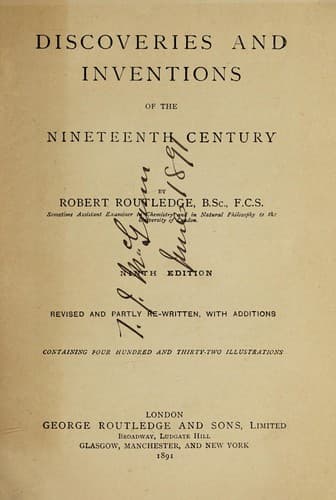
Discoveries and Inventions of the Nineteenth CenturyRoutledge, Robert
History
Discoveries and Inventions of the Nineteenth Century
Routledge, Robert
Inventions -- History -- 19th century
reducing his expenses at one period to the modest sum of £400 per annum.
Before his death, the Duke, for taxation purposes, estimated his income
at £110,000 per annum. Before the railway system was fully established a
network of canals had united the most populous places in England, the
total length of the waterways being not much less than two thousand
miles. With the rise of railways the importance of canals as channels
for the conveyance of merchandise declined. But, nevertheless, in
consequence of the continued increase of traffic and the great cheapness
with which goods can be carried by water, canals are often able to
compete with railways in the carriage of bulky or heavy goods when speed
of transit is not an object. The English canals have, therefore, never
been disused or abandoned, notwithstanding the ubiquitous ramifications
of the railway lines. Nay, the value of the Bridgewater Canal system,
about to be superseded so far as concerns the communication between
Liverpool and Manchester by the greater scheme we have presently to
describe, is such that £1,710,000 is now required for its purchase; and
that is the value in spite of four lines of railway connecting those
great towns, and all competing for the carriage of goods. In these
canals, designed for inland communication only, the navigation is
confined to boats or barges of very insignificant dimensions compared
with the sea-going ships that some great modern canals are constructed
to receive.
To the present century belongs the famous “Caledonian Canal,” as the
waterway is often called that extends in a straight line for more than
60 miles across Scotland, in north-east and south-west directions. The
canal work here was commenced in 1802, under the direction of Telford,
and though it was opened for traffic in 1822, the work as it now exists
was not completed until 1847. But the length of the actual canal
construction in this case did not much exceed 23 miles, for a natural
waterway, navigable for ships of any burden, is formed by the series of
narrow lakes that fill what is called the “Great Glen of the Highlands.”
This glen has many of the characteristics of a great artificial ditch:
its highest point is only 90 feet above the tide level in Loch Linnhe; a
circumstance not a little remarkable in so mountainous a country. What
is also remarkable is the great depth of these lakes, which in some
places exceeds 900 feet. The banks also are generally very steep, and
indeed at one time it was impracticable to pass along the shores of Loch
Ness, the longest of the lakes. But there are now good roads along both
banks. Although the ground traversed by the artificial channels of the
Caledonian Canal is chiefly alluvial, the cost of the undertaking proved
to be great, amounting, it is said, to about one and a quarter million
pounds sterling. Indeed, had it not been for the introduction of steam
navigation before the completion of the work, and the consequent
Public-domain text, read in full here on John Shaqi.
Reviews
Reviews
No reviews yet
Be the first to share your thoughts on this work.
Elsewhere in the archive
Join the Discussion
Join the discussion
Sign in to leave a comment or review.
Sign InorCreate an account