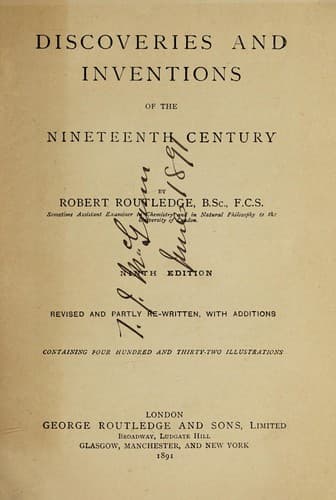
Discoveries and Inventions of the Nineteenth CenturyRoutledge, Robert
History
Discoveries and Inventions of the Nineteenth Century
Routledge, Robert
Inventions -- History -- 19th century
For at that period travellers going to India in the famous sailing
ships, called “East Indiamen,” were obliged to sail round the Cape of
Good Hope and pass from the Southern to the Indian Ocean. The reader who
wishes to understand the importance of the Suez Canal should look at the
map of the Eastern Hemisphere, where he will have no difficulty in
finding the position of the vast continent of Africa, which is washed on
the north by the Mediterranean Sea, on the west by the Atlantic, on the
south by the Southern Ocean, and on the east and north-east by the
Indian Ocean and the Red Sea. If he now traces the waterway round
Africa, on coming to the head of the Red Sea he will find the only
interruption of the oceanic continuity in the narrow neck of land called
the Isthmus of Suez. But for this, ships might long ago have made
complete circuits round this vast, and, even as yet, but partially
explored continent. The circuit would, indeed, be a great one of some
15,000 miles; but the barrier that the Isthmus presented to
inter-oceanic communication between the eastern and the western worlds
was a piece of physical geography which has undoubtedly been a most
important factor in determining the course of history. It has been said
that had there existed at Suez a strait like that of Gibraltar or that
of Messina, instead of a sandy isthmus, the achievements of Diaz, Vasco
da Gama, and Columbus would have lost much of their significance; but
the advantages to the world’s commerce would have been incalculable, and
the progress of the race might have been more rapid.
The Emperor Napoleon I. had the idea of restoring the old canal; but it
was only when steam navigation had taken its place on the seas that the
scheme was looked upon as offering any chance of financial success. But
General Chesney, who made some surveys for the French Government in
1830, had come to the conclusion that there was a considerable
difference of level between the two seas—a difference, he calculated, of
about 30 feet. The existence of such a state of things would, of course,
have been very unfavourable for the undertaking; but the General’s
supposition was soon proved to have been erroneous.
Public-domain text, read in full here on John Shaqi.
Reviews
Reviews
No reviews yet
Be the first to share your thoughts on this work.
Elsewhere in the archive
Join the Discussion
Join the discussion
Sign in to leave a comment or review.
Sign InorCreate an account