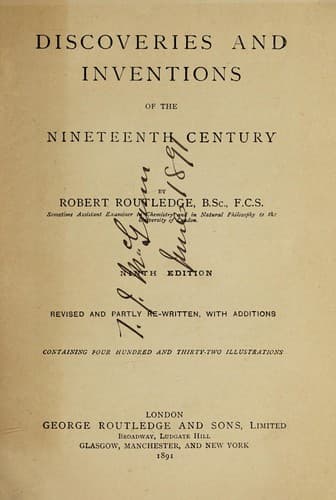
Discoveries and Inventions of the Nineteenth CenturyRoutledge, Robert
History
Discoveries and Inventions of the Nineteenth Century
Routledge, Robert
Inventions -- History -- 19th century
increase and facility of water conveyance, it is doubtful whether the
utility of this canal would have been commensurate with its cost, or its
receipts have made any profit for its promoters. By the Caledonian Canal
large steamers and other vessels may pass from sea to sea, and in the
summer time the steamers that traverse it are crowded with tourists
attracted by the magnificent scenery it presents throughout the greater
part of its length.
But whatever had previously been done in canal construction was
surpassed in enterprise and importance by Lesseps’ great work in Egypt.
_THE SUEZ CANAL._
As we have already seen, the idea of opening a waterway between the Red
Sea and the Mediterranean is by no means a product of the present
century. The ancient Egyptians do not appear to have cut directly
through the Isthmus, but Herodotus describes a canal made by Necho about
the year 600 B.C., from Suez through the Bitter Lakes to Lake Timsah and
then westward to Bubastis on the Nile. He mentions certain water gates,
and states that vessels took four days in sailing through. This canal
became silted up with sand ages ago, but it was cleared out again and
re-opened in the seventh century of our era by the Caliph Omar, and
traces of it are still visible. According to some recent discoveries in
the chief archives of Venice, as early as the end of the fifteenth
century, when Vasco da Gama had discovered the Cape of Good Hope, and
the Portuguese took that new route to India, hitherto the exclusive
property of the Venetian and Genoese merchants, a re-cutting of the
Isthmus of Suez was thought of. Plans were prepared and embassies sent
to Egypt for paving the way for the accomplishment of this great
enterprise, which, it is said, was only foiled by the persistent
opposition of some patricians, who were probably bribed by foreign gold
to prevent the execution of the plan. One of our Elizabethan poets,
Christopher Marlowe, appears, in the following lines, to have
anticipated M. de Lesseps:—
“Thence marched I into Egypt and Arabia,
And here, not far from Alexandria,
Whereat the Terrene and the Red Sea meet,
Being distant less than full a hundred leagues.
I meant to cut a channel to them both,
That men might quickly sail to India.”
Public-domain text, read in full here on John Shaqi.
Reviews
Reviews
No reviews yet
Be the first to share your thoughts on this work.
Elsewhere in the archive
Join the Discussion
Join the discussion
Sign in to leave a comment or review.
Sign InorCreate an account