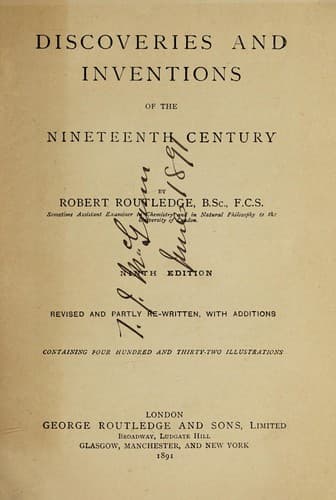
Discoveries and Inventions of the Nineteenth CenturyRoutledge, Robert
History
Discoveries and Inventions of the Nineteenth Century
Routledge, Robert
Inventions -- History -- 19th century
Iron has also been called “the mainspring of civilization,” and the
significance of the phrase is obvious enough when we consider the
enormous number and infinite variety of the things that are made of it:
the sword and the ploughshare; all our weapons of war and all our
implements of peace; the slender needle and the girders that span wide
rivers; the delicate hair-spring of the tiny watch and the most
tenacious of cables; the common utensils of domestic life and the huge
battle-ships of our fleets; the smoothest roads, the loftiest towers,
the most spacious pleasure palaces. Such extensive applications of iron
for purposes so diverse have been rendered possible only by the greater
facility and cheapness of production, together with the better knowledge
of the properties of the substance and increased skill in its treatment,
that have particularly distinguished our century. Apart again from the
constructive uses of iron, it enters essentially into another class of
inventions of which the age is justly proud, namely, those which utilize
electricity in the production of light, mechanical power, and chemical
action; for it is on a quality possessed by iron, and by _iron alone_,
that the generation of current by the electric dynamo ultimately
depends. This peculiar property of iron, which was first announced by
Arago in 1820, and has since proved so fertile in practical
applications, is that a bar of the metal can, under suitable conditions,
be instantly converted into the most powerful of magnets, and as quickly
demagnetized. What these conditions are will be explained when we come
to treat of electricity.
[Illustration:
FIG. 16.—_Aerolite in the British Museum._
]
Public-domain text, read in full here on John Shaqi.
Reviews
Reviews
No reviews yet
Be the first to share your thoughts on this work.
Elsewhere in the archive
Join the Discussion
Join the discussion
Sign in to leave a comment or review.
Sign InorCreate an account