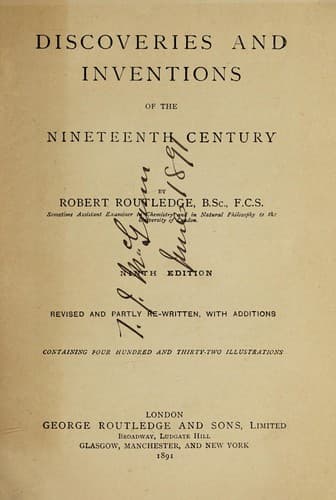
Discoveries and Inventions of the Nineteenth CenturyRoutledge, Robert
History
Discoveries and Inventions of the Nineteenth Century
Routledge, Robert
Inventions -- History -- 19th century
Besides the unique property of iron just referred to, and its
superlative utility in arts and industries, there are other
circumstances that give a peculiar interest to this metal. It is the
chief constituent of many minerals, and traces or small quantities are
found in most of the materials that make up the crust of the earth; it
is present also in the organic kingdoms, being especially notable in the
blood of vertebrate (_back-boned_) animals, of which it is an essential
component. Notwithstanding its wide diffusion, iron is not found
_native_, that is, as _metal_, but has to be extracted from its _ores_,
which are usually dull stony-looking substances, as unlike the metal as
can be conceived. In this respect it differs from gold, which is not met
in any other than the metallic state, in the form of _nuggets_, minute
crystals or branching filaments, and from metals such as silver, copper,
and a few others which also are occasionally found native. It is true
that rarely small quantities of metallic iron have been met with in the
form of minute grains disseminated in volcanic rocks; but in contrast
with the practical absence of metallic iron from terrestrial accessible
materials is the fact that masses of iron, sometimes of nearly pure
metal, occasionally descend upon the earth from interplanetary space.
These are _aerolites_, of which there are several varieties, some
consisting only of crystalline minerals without any metallic iron,
others of a mixture of minerals and metals, but the most common are of
iron, always alloyed with a small quantity of nickel, and usually
containing also traces more or less of a few other metals and known
chemical elements. The iron in some specimens has been found to amount
to 93 per cent. of the whole. These _aerolites_, or _meteorites_, as
they are also called, are of irregular shape and vary greatly in size,
which however is sometimes very considerable: one found in South America
was calculated to weigh 14 tons, another discovered in Mexico, 20 tons.
There is in the British Museum a good specimen of an iron meteorite,
which is represented in Fig. 16, where it will be observed that a
portion has been cut off to form a plane surface, which when polished
and etched by an acid, reveals a crystalline structure quite peculiar
and distinctive, so that such meteorites can be recognized with
certainty, even if they did not possess surface characters which are
easily observed and identified when once a specimen has been examined.
The fall of meteorites to the surface of the earth is comparatively
rare, but it has been witnessed by even scientific observers; as when
Gassendi, the French astronomer, saw in Provence the fall of a meteorite
weighing 59 lbs. In the _Transactions of the Royal Society_ for 1802 may
be found a detailed account of an instance in England of the fall which
took place in Yorkshire, on the 13th December 1795, of a stone 56 lbs.
in weight. Aerolites become ignited or incandescent by reason of the
Public-domain text, read in full here on John Shaqi.
Reviews
Reviews
No reviews yet
Be the first to share your thoughts on this work.
Elsewhere in the archive
Join the Discussion
Join the discussion
Sign in to leave a comment or review.
Sign InorCreate an account