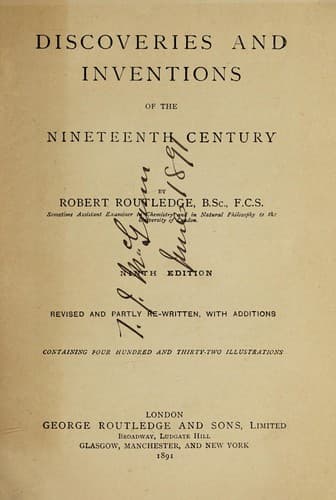
Discoveries and Inventions of the Nineteenth CenturyRoutledge, Robert
History
Discoveries and Inventions of the Nineteenth Century
Routledge, Robert
Inventions -- History -- 19th century
It need scarcely be said that great care and expense are bestowed on the
construction of these furnaces. Only the best and most refractory
materials, such as firebricks, are used for the lining, and the exterior
is a casing of solid masonry, strengthened with iron bands. When a new
furnace is finished it takes a month or six weeks to put it into
operation; but when this is done it will remain in action night and day
continuously for a long period—perhaps for eight or ten years—before the
necessity for repairs requires a “blow out.” And the blow out and
restarting, without the cost of repairs, entail an outlay of several
hundred pounds.
The gases leaving the throat of the furnace consist mainly of nitrogen
and a little carbonic acid, together with about one-third of their
volume of the combustible gases, carbonic oxide, and some hydrogen; but
these last do not leave the furnace in an ignited state, because the
oxygen there has already been consumed. They are conducted by the
“down-come” pipe, G, Fig. 22, to a point at which, by means of a valve,
they can be directed to one or other of two circular towers entirely
filled with firebricks, arranged chequerwise, so as to form innumerable
passages between them. The furnace gases are admitted at the bottom of
the Cowper tower, or “regenerative stove,” into a flue to which a
regulated quantity of air has access, and there they are fired: the
flame ascending the flue to the upper part of the tower, thence
descends, communicating its heat to the firebricks, which soon acquire a
very high temperature, especially where the flame first enters, and the
burnt gases leave the tower for a tall chimney, leaving most of their
heat in the firebricks. When this action has continued for a sufficient
time, the connection of the regenerator with the throat of the furnace
is cut off, and the escaping gases are directed into the other
regenerator, and at the same time the blast from the blowing engine is
made to ascend among the firebricks of the first, where gaining
increasing temperature as it ascends—the stove being hottest at the
top—the air leaves the tower to be conducted to the _tuyères_ at such
high temperature as already mentioned. While the one regenerator is thus
heating the blast, the other is in its turn accumulating heat from the
flames of the escaping gases; and thus they are worked alternately, the
action being constantly reversed after suitable intervals.
Public-domain text, read in full here on John Shaqi.
Reviews
Reviews
No reviews yet
Be the first to share your thoughts on this work.
Elsewhere in the archive
Join the Discussion
Join the discussion
Sign in to leave a comment or review.
Sign InorCreate an account