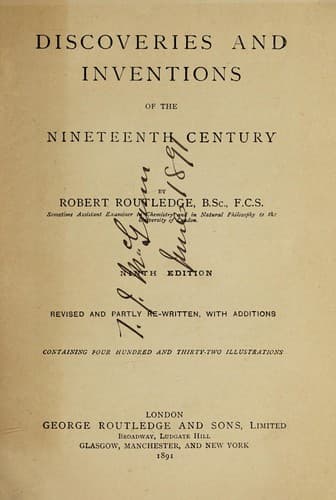
Discoveries and Inventions of the Nineteenth CenturyRoutledge, Robert
History
Discoveries and Inventions of the Nineteenth Century
Routledge, Robert
Inventions -- History -- 19th century
When iron is combined with a much smaller proportion of carbon than in
cast iron, and contains little or no graphitic or uncombined carbon, we
have the very useful compound known as steel. In the earlier half of the
century it was customary to distinguish steel from malleable iron on the
one hand, and cast iron on the other. If the compound contained from 0·5
to 1·5 per cent. of carbon, it was called steel by some authorities,
while others extended these limits a little on either side. Later it was
found that the presence of elements other than carbon can confer steely
properties on iron, and indeed it is possible to have a metal containing
no carbon, but possessing the characteristic properties of steel. Sir
Joseph Whitworth proposed to classify a piece of metal according to its
tensile strength, without any regard to either its chemical composition
or its mode of manufacture: if it could not bear more than 30 tons per
square inch it should be considered iron, but if it had a higher tensile
strength, it should then be regarded as steel. To estimate the
engineering value a figure depending upon the elongation or stretching
of the specimen before breaking was to be added to the number of tons of
the breaking load. This stretching power of steel is in some cases of as
much importance as the tensile strength: the ordnance maker, for
instance, considers a steel with a breaking strength of 53 tons under an
elongation of 5 per cent. as _for his purposes_ to be rejected: while a
specimen showing a breaking strain of only 30 tons along with an
elongation of 35 per cent., on 2 inches of length, he will regard as
good. The tensile strength of steel depends in part on its composition,
in part on the mode of manufacture, and in part on the subsequent
treatment. The _average_ tensile strength of a wrought iron bar per
square inch of section is about 25 tons (30 is the maximum); while the
like average for steel is 43 tons, and some kinds of cast steel will
bear nearly 60 tons. Steel bars of a certain temper subjected by Sir
Joseph Whitworth to a process of hardening in oil showed a tensile
strength of even 90 tons per square inch. These figures will suffice to
show the great utility of steel in structures and machines. But steel
has besides a characteristic property which makes it extremely valuable
in a great variety of applications, namely, its capability of being
_tempered_. If a piece of steel is heated to dull redness and suddenly
cooled by plunging it into cold water, it becomes so extremely hard that
it cannot be acted on by a file; nay, its hardness may be made to rival
that of the diamond, which is the hardest substance known. Now by a
second operation this hardness can be reduced to any required degree:
this is done by re-heating the metal to a certain moderate degree
between 430° F. and 630° F. and again cooling it by immersion in some
cooling medium. In this “letting down” process, it is the highest
Public-domain text, read in full here on John Shaqi.
Reviews
Reviews
No reviews yet
Be the first to share your thoughts on this work.
Elsewhere in the archive
Join the Discussion
Join the discussion
Sign in to leave a comment or review.
Sign InorCreate an account