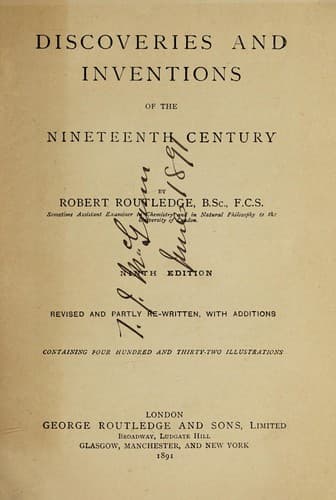
Discoveries and Inventions of the Nineteenth CenturyRoutledge, Robert
History
Discoveries and Inventions of the Nineteenth Century
Routledge, Robert
Inventions -- History -- 19th century
The headpiece to our chapter on Fire-Arms gives but a very inadequate
idea of the magnitude of the Essen Works about 1870. A better notion
will be obtained from a few figures which we select from a list giving
some of the contents of the Essen Works in 1876. There were 1,109
furnaces of various kinds, of which 250 were for smelting; 77 steam
hammers, 294 steam engines, 18 rolling mills, 365 turning lathes, and
700 other machine tools; 24 miles of ordinary gauge railway for traffic
within the works; together with 10 miles of narrow gauge railway; 38
miles of telegraph lines, with 45 Morse apparatus, etc. (J. S. Jeans’
_Steel: its History, etc._, 1880). These figures belong, be it observed,
to the state of things in 1876; but we learn from a later authority that
in 1894 these works employed 15,000 men, and we must suppose that the
plant has been proportionately increased since the earlier period, when
10,000 men were employed.
In the year 1854 a regular system of records began to be kept of the
amounts of coal and ores raised in Great Britain, and also of the
quantities of the various metals produced. These show that in 1894 very
nearly three times as much coal was raised as in 1854, and that in the
same period the quantity of British pig iron smelted annually had
increased four-fold; these increases look small when compared with the
expansion of the steel production in Britain within the same period of
forty years, for this had enlarged _thirty-fold_. This extraordinary
development is attributable to the introduction of two processes by
either of which various steels of excellent quality, and adapted to a
great range of applications, can be produced cheaply and with certainty.
These processes are respectively known as the Bessemer and the Open
Hearth, and the reader should observe that with the main principles
involved in these he has already been made acquainted.
Public-domain text, read in full here on John Shaqi.
Reviews
Reviews
No reviews yet
Be the first to share your thoughts on this work.
Elsewhere in the archive
Join the Discussion
Join the discussion
Sign in to leave a comment or review.
Sign InorCreate an account