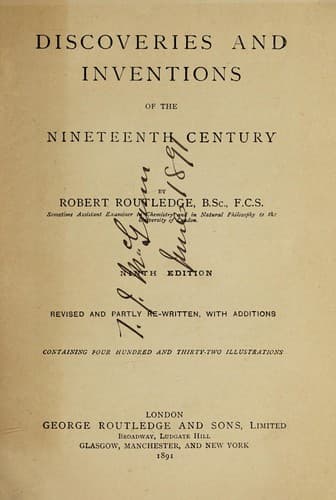
Discoveries and Inventions of the Nineteenth CenturyRoutledge, Robert
History
Discoveries and Inventions of the Nineteenth Century
Routledge, Robert
Inventions -- History -- 19th century
widow was on petition granted an extension of it for seven years. The
nature of the influence of manganese on steel-making has not been fully
explained, and there is some diversity of opinion on the subject, as it
is said—on the one hand, merely to remove or counteract the injurious
effects of sulphur or phosphorus; on the other, to impart to the steel
greater ductility, strength, and power of welding, tempering, etc.
The manufacture of _crucible_ or _cast steel_ has been carried on at
Essen in Prussia by the firm of A. Krupp & Co., on a scale surpassing
anything attempted elsewhere,—theirs being the largest steel-works in
the world, and remarkable for the variety and excellence of its
products. It began in so small a way that it is said only a single
workman was employed. To the Great Exhibition of 1851, at London,
Krupp’s firm sent a block of crucible cast steel weighing 2¼ tons, a
larger mass of the metal than had ever been shown before, and looked
upon with no little astonishment, for at that time steel was a precious
commodity, the price of refined steel ranging from £45 to £60 per ton.
At the next London Exhibition, in 1862, the Essen Works showed a block
of cast steel 20 tons in weight, and at the Vienna Exhibition of 1873,
one of 52 tons. This casting, which was first made of a cylindrical
shape, was forged into an octagonal form under an immense steam-hammer,
larger than the Woolwich hammer described on a previous page, for the
weight of the moving part is no less than 50 tons. This huge mass of
cast steel was of the finest quality; the forging into the prismatic
form was to show its malleability, for it was intended for the body of a
gun to have a bore of 14 inches. Since the period referred to, ingots of
more than 100 tons have been cast. That shown at Vienna was the product
of some 1,800 crucibles, each containing 65 lbs. of melted steel, which
had to be poured into the mould in a regular and continuous stream, so
that the metal might solidify into a perfectly uniform mass. Such work
can be done only by trained men, who act in regular ranks with military
precision, and in pairs emptying their crucibles into channels
previously assigned, then filing off to the other end of the rank to
receive another crucible, while the pair of men who were behind are
pouring out theirs, and so on in succession. The crucibles are emptied
into a number of channels formed of iron lined with fire-clay, and
leading down into the mould. Many precautions have to be taken to ensure
the regular progress of the operations, and all the time required to
fill the huge moulds may be counted by minutes.
Public-domain text, read in full here on John Shaqi.
Reviews
Reviews
No reviews yet
Be the first to share your thoughts on this work.
Elsewhere in the archive
Join the Discussion
Join the discussion
Sign in to leave a comment or review.
Sign InorCreate an account