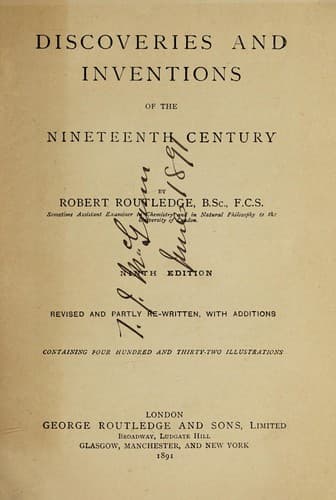
Discoveries and Inventions of the Nineteenth CenturyRoutledge, Robert
History
Discoveries and Inventions of the Nineteenth Century
Routledge, Robert
Inventions -- History -- 19th century
The startling novelty of the methods and results described in this paper
had the effect of paralyzing discussion at the time. But soon the voice
of detraction was heard; many iron-masters ridiculed the idea of
producing iron and steel without fuel, and indeed it may have been
observed, the title of the paper notwithstanding, that first the silicon
and carbon, and then the iron itself, really supplied the fuel. And we
must remember that malleable iron in a molten state was then deemed an
impossibility, for the hottest furnaces then known could not effect the
fusion, however prolonged their action might be, yet Bessemer was to
obtain five tons in this condition in the short space of half an hour
with no other aid than cold air. Then it was said that Bessemer’s
process of forcing air into melted cast iron had no claim of novelty,
for it had been tried before and found valueless. Some iron-masters on
trying experiments on a small scale and with imperfect appliances met
with failures, and discredited the process at once; but five large
establishments paid for licences sums amounting to £26,500 within three
weeks of the reading of the paper. At the works of the Dowlais Iron Co.,
in South Wales, who were the first licensees, the first converter was
set up under Bessemer’s personal superintendence, and at the first
operation five tons of iron were produced direct from the blast furnace
pig. This apparently satisfactory result proved quite otherwise when
this iron came to be practically tested; for it was found quite useless!
It was both “_cold-short_” and “red-short,” to use the technical
terms,—the former of which means that although the sample may be welded,
it is when cold brittle and rotten; the latter means that at a low red
heat it breaks and crumbles under the hammer. Further trials were made,
new experiments instituted, but the success that attended Bessemer’s
early experiments could not be repeated, and as yet no one knew the
reason why. Now it so happened that in the preliminary experiments an
exceptionally pure pig iron had been made use of containing little or no
phosphorus or sulphur, substances very deleterious in iron, and still
more so in steel. With the capital obtained by the sale of his licences
Bessemer quietly set to work to investigate the cause of his
non-success, making daily experiments with a ton or two of metal at a
time. These experiments extended over a period of two and a half years,
and upon them Bessemer and his partner spent about £16,000, besides the
£4,000 the preliminary researches had cost. But all difficulties were at
length overcome, and the process was now found capable of turning out
pure iron and steel when the pure pig iron of Sweden was used in the
converter. In the meantime the licensees had made no attempts
practically to carry out the process, which began to be denounced as
visionary: it was “a mare’s nest”; it was “a meteor that had passed
Public-domain text, read in full here on John Shaqi.
Reviews
Reviews
No reviews yet
Be the first to share your thoughts on this work.
Elsewhere in the archive
Join the Discussion
Join the discussion
Sign in to leave a comment or review.
Sign InorCreate an account