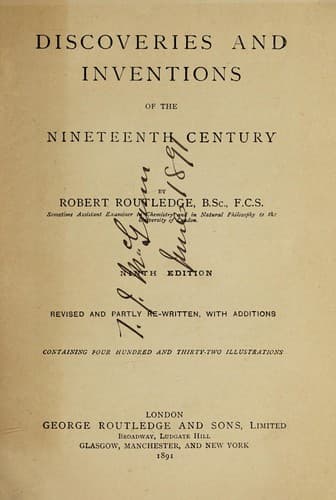
Discoveries and Inventions of the Nineteenth CenturyRoutledge, Robert
History
Discoveries and Inventions of the Nineteenth Century
Routledge, Robert
Inventions -- History -- 19th century
“I beg to call your attention to an important fact connected with the
new process which affords peculiar facilities for the manufacture of
cast steel. At that stage of the process immediately following the boil
the whole of the crude iron has passed into the condition of cast steel
of ordinary quality. By the continuation of the process the steel so
produced gradually loses its small remaining portion of carbon, and
passes successively from hard to soft steel, and from soft steel to
steely iron, and eventually to very soft iron; hence, at a certain
period of the process, any quality of metal may be obtained. There is
one in particular which by way of distinction I call semi-steel, being
in hardness about midway between ordinary cast steel and soft malleable
iron. This metal possesses the advantage of much greater tensile
strength than soft iron; it is also more elastic, and does not readily
take a permanent set, while it is much harder and is not worn or
indented so easily as soft iron; at the same time it is not so brittle
or hard to work as ordinary cast steel. These qualities render it
eminently well adapted to purposes where lightness and strength are
specially required, or where there is much wear, as in the case of
railway bars, which from their softness and lamellar texture soon become
destroyed. The cost of semi-steel will be a fraction less than iron,
because the loss of metal that takes place by oxidation in the
converting vessel is about 2½ per cent. less than it is with iron; but
as it is a little more difficult to roll, its cost per ton may fairly be
considered to be the same as iron; but as its tensile strength is some
30 or 40 per cent. greater than bar iron, it follows that for most
purposes a much less weight of metal may be used than that so taken. The
semi-steel will form a much cheaper metal than any we are at present
acquainted with. These facts have not been elicited from mere laboratory
experiments, but have been the result of working on a scale nearly twice
as great as is pursued in our largest iron works, the experimental
apparatus doing 7 cwt. in thirty minutes, while the ordinary puddling
furnace makes only 4½ cwt. in two hours, which is made into six separate
balls, while the ingots or blooms are smooth, even prisms, 10 in. square
by 30 in. in length, weighing about equal to ten ordinary puddle balls.”
Public-domain text, read in full here on John Shaqi.
Reviews
Reviews
No reviews yet
Be the first to share your thoughts on this work.
Elsewhere in the archive
Join the Discussion
Join the discussion
Sign in to leave a comment or review.
Sign InorCreate an account