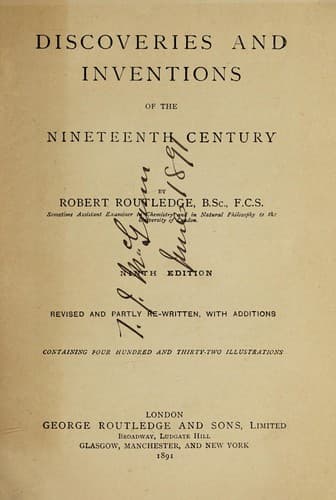
Discoveries and Inventions of the Nineteenth CenturyRoutledge, Robert
History
Discoveries and Inventions of the Nineteenth Century
Routledge, Robert
Inventions -- History -- 19th century
The development of the Bessemer process soon had the effect of so
reducing the price of steel that this material came into use for almost
every purpose for which iron had previously been employed, such as
railway bars, girders, etc., for bridges, boiler plates, etc., for all
which “steely iron” containing only 0·12 to 0·40 per cent. carbon proved
admirably adapted. The practical success of the Bessemer process had not
long been demonstrated commercially by the inventor and his partners at
Sheffield before other firms began the manufacture: so that in 1878
there were in Great Britain alone twenty-seven establishments making
Bessemer steel and using 111 converters. It may give an idea of the
magnitude the Bessemer steel manufacture had attained even at that time
if we quote the cost of erecting a complete plant for two 5–ton
converters: it was £44,400, as given in a detailed estimate. In all
these cases pig iron from ores free from phosphorus and sulphur had to
be used, for as we have seen the converter failed to eliminate these
vitiating elements. Imported pig ores had in general to be used, or pig
from the limited supply of British hæmatite ores in West Cumberland. The
Barrow Hæmatite Steel Company engaged in the production of Bessemer
steel on a very large scale, having by 1878 erected no fewer than
sixteen converters of the capacity of 6 tons each. In the meanwhile many
efforts were made to discover some method of eliminating phosphorus, so
that the ordinary qualities of British pig iron, and iron derived in any
part of the world from the coarse phosphorized ores, might be available
for the converter. Many of the methods then devised proved correct in
principle and feasible in practice; but as, for sundry reasons, none of
them came extensively into use, we need not here allude to them further.
Public-domain text, read in full here on John Shaqi.
Reviews
Reviews
No reviews yet
Be the first to share your thoughts on this work.
Elsewhere in the archive
Join the Discussion
Join the discussion
Sign in to leave a comment or review.
Sign InorCreate an account