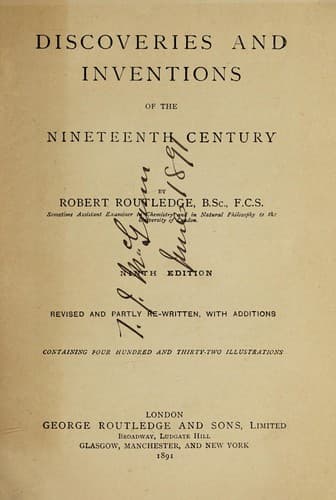
Discoveries and Inventions of the Nineteenth CenturyRoutledge, Robert
History
Discoveries and Inventions of the Nineteenth Century
Routledge, Robert
Inventions -- History -- 19th century
The solution of the problem was announced in 1879. Some years before, G.
J. Snelus had come to the conclusion that with a siliceous lining it
would be impossible to eliminate phosphorus in the Bessemer converter,
and that some refractory substance of a basic character must be sought
for in order that the slag produced should be in a condition to absorb
the phosphoric acid as fast as it is produced. He patented in 1872 the
use of magnesian limestone as a material for the lining; as that
substance when intensely heated became very hard and stony, being in
that condition quite unaffected by water. Two young chemists, Messrs.
Thomas and Gilchrist, apparently without being aware of Mr. Snelus’s
conclusions, had also convinced themselves that the chief deficiency in
the Bessemer process was due to the excess of silica in the slag, and in
1874 they began to try the effect of basic linings, and also of basic
additions, such as lime, etc., to the charge in the converter, so that
the lining itself should not be worn out by entering into the slag.
Their results proved that phosphorus could be eliminated when the slag
contained excess of a strong base. An example of an operation at
Bolckow, Vaughan, & Company’s Eston works with the highly phosphorized
Cleveland pig iron may be quoted. The basic-lined converter received
first 9 cwt. of lime, then 6 tons of metal. When the blast at 25 lbs.
pressure was turned on, the silicon began at once to burn; for three
minutes the carbon was not affected, but for fourteen minutes longer it
regularly diminished, the silicon keeping pace with it. After the blow
had been continued for thirteen minutes from the commencement, the
converter was turned down to allow of the further introduction of 19½
cwt. of a mixture of two parts of lime with one of oxide of iron. So
long as 1·5 per cent. of carbon remained in the metal the phosphorus was
untouched, and at the end of the blow, _i.e._ when the flame dropped,
only one-third of it had been eliminated; it still formed 1 per cent. of
the metal. The blast continued for another two minutes brought it down
to ¼ per cent., and in one more minute only a trace was left. Most of
the sulphur was got rid of at the same time. From Cleveland pig, thus
de-phosphorized in the Bessemer converter, large quantities of steel
rails were rolled for the North Eastern Railway Company, and were found
entirely satisfactory, being as good as those made from the Cumberland
hæmatite steel. This de-phosphorized process has been brought into
operation wherever phosphoric ores are dealt with, and it has been
applied with equal success in the “open hearth” furnaces, of which we
have now to speak.
Public-domain text, read in full here on John Shaqi.
Reviews
Reviews
No reviews yet
Be the first to share your thoughts on this work.
Elsewhere in the archive
Join the Discussion
Join the discussion
Sign in to leave a comment or review.
Sign InorCreate an account