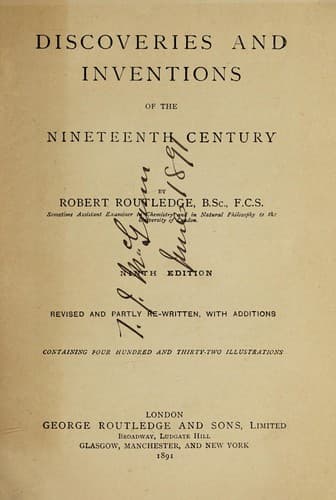
Discoveries and Inventions of the Nineteenth CenturyRoutledge, Robert
History
Discoveries and Inventions of the Nineteenth Century
Routledge, Robert
Inventions -- History -- 19th century
All discoveries and all inventions may be traced back to preceding
discoveries and inventions in an endless series, and it is only by its
precursors that each in its turn has been made possible. If we take one
of the greatest marvels brought into existence at nearly the close of
our epoch, namely, “wireless telegraphy,” we may follow up links of a
chain connecting it with the recorded observations of an ancient Greek
(Thales) who flourished seven centuries before our era, and even these
may not have been original discoveries of his. And it will have been
gathered from what has already been said that steel must have been
produced, however unwittingly, at the earliest period at which man began
to reduce iron from its ores. So the very latest, and for many purposes
the most extensively practised, process of modern steel-making, brought
indeed to working perfection mainly by the perseverance and scientific
insight of two individuals, is the result of the observation and the
accumulated experience of former generations. The observations and
experience here alluded to are chiefly those that follow two lines: one
concerning the properties of the metal itself, the other relating to the
means of commanding very high temperatures on a great scale. On this
occasion we are able almost to lay a finger on some proximate links of
the chain. Réaumur, the French naturalist, made steel in the early part
of the eighteenth century by melting cast iron in a crucible, and in
this liquid metal he dissolved wrought iron, the product being, as the
reader will now easily understand, the intermediate substance, steel;
and this was obtained of course at a temperature which was incapable of
fusing wrought iron by itself. He published in 1722 a treatise on “The
Art of converting Iron into Steel, and of softening Cast Iron.” For
this, and certain other metallurgical discoveries, Réaumur received a
life-pension equivalent to about £500 per annum,—a treatment very
different from that dealt out by the British to Henry Cort. The action
in Réaumur’s crucible is precisely that used on the large scale in
Siemens’ open hearth. But this last became possible only when Siemens
had worked out his “regenerative stove” or heat accumulator, the
development of an idea suggested by a Dundee clergyman in 1817.
Public-domain text, read in full here on John Shaqi.
Reviews
Reviews
No reviews yet
Be the first to share your thoughts on this work.
Elsewhere in the archive
Join the Discussion
Join the discussion
Sign in to leave a comment or review.
Sign InorCreate an account