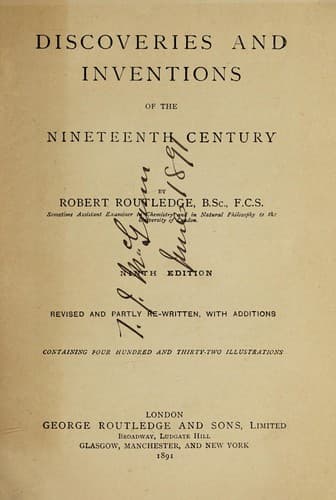
Discoveries and Inventions of the Nineteenth CenturyRoutledge, Robert
History
Discoveries and Inventions of the Nineteenth Century
Routledge, Robert
Inventions -- History -- 19th century
Everyone knows how much iron is used in those great engineering
structures that mark the present age, and of which a few examples will
be described in succeeding articles. One other feature of the nineteenth
century is the use of iron in architecture. Some have, indeed, protested
against the use of iron for this purpose, and would even deny the name
of architecture to any structure obviously or chiefly formed of that
material. Stone and wood, they say, are the only proper materials,
because each part must be wrought by hand, and cannot be cast or
moulded; and further, iron being liable to rust, suggests decay and want
of permanence, and these are characters incompatible with noble
building. All this can rest only on a relative degree of truth—as, for
instance, machinery is used to dress and shape both wood and stone, and
the permanence of even the latter is as much dependent on conditions as
that of iron. Iron used in architecture is hideous when applied in
shapes appropriate only to stone; but when it is disposed in the way
suggested by its own properties, and receives ornament suitable to its
own nature, the result is harmonious and graceful, and the structure may
display beauties that could be attained by no other materials. Be that
as it may, the great and lofty covered spaces that are required for our
railway stations and for other purposes could have been obtained only by
the free use of iron, and everyone can recall to mind instances of such
structure not devoid of elegance, in spite of the absence—the proper
absence—of the Classic “orders” or Gothic “styles.” The first notable
instance of the application of iron on a large scale was the erection of
the “Crystal Palace,” in Hyde Park, for the great Exhibition of 1851. It
was taken down and re-erected at Sydenham, and there it has become so
well known to everyone that any description of it is quite unnecessary
in this place.
As another conspicuous example of what may be done with iron, the Eiffel
Tower at Paris may be briefly described.
Public-domain text, read in full here on John Shaqi.
Reviews
Reviews
No reviews yet
Be the first to share your thoughts on this work.
Elsewhere in the archive
Join the Discussion
Join the discussion
Sign in to leave a comment or review.
Sign InorCreate an account