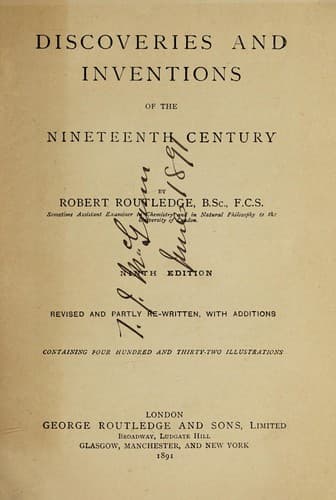
Discoveries and Inventions of the Nineteenth CenturyRoutledge, Robert
History
Discoveries and Inventions of the Nineteenth Century
Routledge, Robert
Inventions -- History -- 19th century
The idea of erecting a tower 1,000 feet high was not of itself new. It
had been entertained in England as early as 1833, in America in 1874,
and in Paris itself in 1881. It has been reserved for M. Gustave Eiffel,
a native of Dijon, who commenced to practise as an engineer in 1855, to
realize this ambitious project. He has long been occupied in the
construction of great railway bridges and viaducts, and in these he has
adopted a system peculiar to himself of braced wrought-iron piers
without masonry or cast-iron columns. He also was the first French
engineer to erect bridges of great span without scaffolding. In the
Garabit viaduct he planned an arch of 541 feet, crossing the Truyère at
a height of nearly 400 feet above it. One result of M. Eiffel’s studies
in connection with these lofty piers was his proposal to erect the tower
for the Paris Exhibition of 1889. This proposal met with great
opposition on the part of many influential people in Paris—authors,
painters, architects, and others protesting with great energy against
the modern Tower of Babel, which was, as they said, to disfigure and
profane the noble stone buildings of Paris by the monstrosities of a
machine maker, etc. etc. The Eiffel Tower is now constructed, and no one
has heard that it has dishonoured the monuments of Paris, for it has
been instead a triumph of French skill, the glory of its designer, and
the wonder of the Exhibition.
[Illustration:
FIG. 26_b_.—_The Eiffel Tower in course of construction._
]
Public-domain text, read in full here on John Shaqi.
Reviews
Reviews
No reviews yet
Be the first to share your thoughts on this work.
Elsewhere in the archive
Join the Discussion
Join the discussion
Sign in to leave a comment or review.
Sign InorCreate an account