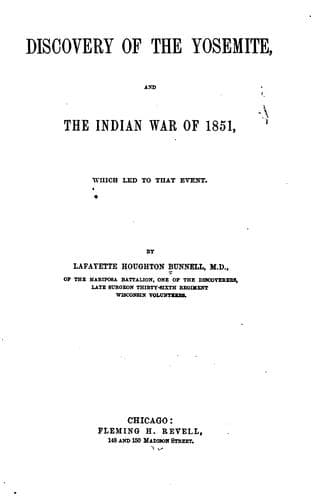
Discovery of the Yosemite, and the Indian War of 1851, Which Led to That EventBunnell, Lafayette Houghton
History
Discovery of the Yosemite, and the Indian War of 1851, Which Led to That Event
Bunnell, Lafayette Houghton
Indians of North America -- California; Pacific Coast Indians, Wars with, 1847-1865; Yosemite Valley (Calif.)
At this time but few guns were in the possession of these mountain
tribes. Their chief weapons of war and for the chase were bows and
arrows. With these they were very expert at short range, and to make
their weapons effective were disposed to lay in ambush in war, and
upon the trails of their game. Their bows were made from a species of
yew peculiar to the West, from cedar and from a spinated evergreen
tree, rare in Southern California, which, for want of scientific
classification, I gave the name of “nutmeg pine.” It bears a nut
resembling in general appearance that agreeable spice, while the
covering or pulpy shell looks very much like mace. The nut is, however,
strongly impregnated with resin. The leaves are long, hard, and so
sharp that the points will pierce the flesh like sharp steel. The wood
is stronger and more elastic than either the yew, cedar or fir. It is
susceptible of a fine polish. I made a discovery of a small cluster
of this species of tree at the foot of the cascades in the cañon, two
miles below the Yosemite valley, while engaged in a survey of that
locality.[12]
The shafts of their arrows are made of reeds, and from different
species of wood, but the choicest are made of what is called Indian
arrow-wood (Le Hamite). This wood is only found in dark ravines and
deep rocky cañons in the mountains, as it seems to require dampness and
shade. Its scarcity makes the young shoots of a proper growth a very
valuable article of barter between the mountain tribes and those of the
valleys and plains. A locality in the Yosemite valley once famous for
its supply of this arrow-wood, was the ravine called by the Yosemites
“Le Hamite,” (as we might say “the oaks,” or “the pines,”) but which is
now designated as “Indian Cañon.”
Public-domain text, read in full here on John Shaqi.
Reviews
Reviews
No reviews yet
Be the first to share your thoughts on this work.
Elsewhere in the archive
Join the Discussion
Join the discussion
Sign in to leave a comment or review.
Sign InorCreate an account