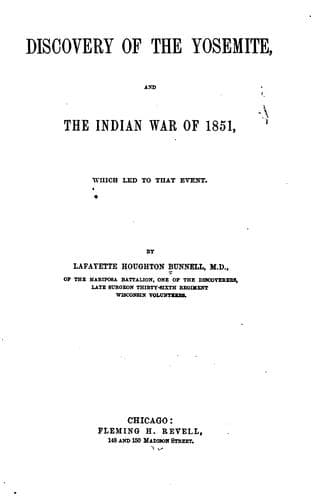
Discovery of the Yosemite, and the Indian War of 1851, Which Led to That EventBunnell, Lafayette Houghton
History
Discovery of the Yosemite, and the Indian War of 1851, Which Led to That Event
Bunnell, Lafayette Houghton
Indians of North America -- California; Pacific Coast Indians, Wars with, 1847-1865; Yosemite Valley (Calif.)
Their arrow-shafts are first suitably shaped, and then polished between
pieces of pumice stone. This stone was also used in fashioning and
polishing their bows, spear-shafts and war clubs. Pumice stone is
found in abundance in the volcanic regions of California and Oregon,
and east of the Sierra Nevada. The quality of the best observed by me,
was much finer and lighter than that seen in the shops as an article
of commerce. The arrow heads are secured to the shaft by threads of
sinew, and a species of cement used for that and other purposes. The
arrow-heads made and in most common use by the California Indians, as
well as by many other tribes in the mountain ranges of the West and
Southwest, are of the same shape and general appearance, and of similar
material, with the exception of obsidian and old junk bottles, as the
arrow heads found in all parts of the United States. They have been
generally supposed to have been made and used by the pre-historic races
that once inhabited this continent. The bow and arrows were in common
use by the aborigines when America was first discovered, and their use
has been continued to the present time among the tribes whose limited
territories were not to any extent intruded upon by the whites.
The Indians of California, unlike those of Southern Mexico and South
America, who use the woorara (strychnos toxifera), poison their
arrow-heads with the poison of the rattlesnake. Some animal’s liver is
saturated with the poison and left until it reaches a state of thorough
decomposition, when the barbs are plunged into the festering mass,
withdrawn and dried. The gelatinous condition of the liver causes the
poison to adhere to the stone, and the strength of the poison is thus
preserved for some days. Only those arrow-heads that are inserted into
a socket, and held in place by cement, are thus poisoned. These are
easily detached after striking an object (the concussion shattering the
cement, and the play of the shaft loosening the barb), and are left to
rankle in the wound.
According to Russio, however, this practice is now seldom resorted to,
except in revenge for some great or fancied injury, or by the more
malignant of a tribe, Indian policy seeming to discountenance a former
custom.
The introduction of fire arms among them, has been from the frontiers
of civilization. The “_flint_,” or more properly cherty rock, when
first quarried, is brittle and readily split and broken into the
desired shapes required, even with the rude implements used by the
Indians; though it is not probable that any but themselves could use
them, as considerable skill seems to be required. The tool commonly
used in the manufacture of arrow-heads, is a species of hammer or pick,
made by fastening the sharp prong of a deer’s horn to a long stick.
Public-domain text, read in full here on John Shaqi.
Reviews
Reviews
No reviews yet
Be the first to share your thoughts on this work.
Elsewhere in the archive
Join the Discussion
Join the discussion
Sign in to leave a comment or review.
Sign InorCreate an account