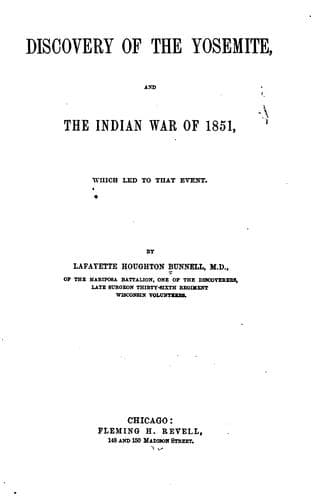
Discovery of the Yosemite, and the Indian War of 1851, Which Led to That EventBunnell, Lafayette Houghton
History
Discovery of the Yosemite, and the Indian War of 1851, Which Led to That Event
Bunnell, Lafayette Houghton
Indians of North America -- California; Pacific Coast Indians, Wars with, 1847-1865; Yosemite Valley (Calif.)
With these instruments of various sizes laminated pieces of rock are
separated, such as slate, with quartz in filtrations, and scales
are chipped from rocks, volcanic and other glass, with a skill that
challenges admiration. Stone hammers, or pieces of hard stone, were
secured by withes and used in some of the processes of flaking; and
I have been assured that steel implements have been stolen from the
miners and used for the same purpose, but I never saw them used.
Arrow-heads were found, made from bones, from chert, obsidian or
volcanic glass, and even old junk bottles, obtained for the purpose,
during their gushing days, from the deserted camps of the libative
miners.
The most approved fire-arms are now found among many of the western
tribes, where but a few years ago bows and arrows were in common use.
Although these hereditary implements of war and of the chase are almost
wholly discarded, occasionally an old-fashioned Indian may be seen,
armed with his bow and arrows, his fire-stick a foot long, occupying
the hole punctured in the lobe of one ear, and his reed-pipe filling
the like position in the other, while his skunk-skin pouch contained
his kin-ne-kin-nick, a piece of spunk and dry charred cedar, on which a
light was obtained by rapid friction with his fire-stick. This method
of procuring fire, has, even among the Indians, been superseded by the
flint and steel, and they in turn by the labor-saving friction matches.
I have, however, recently witnessed the process of lighting a fire by
this primitive process, among the priests of the Winnebago and other
eastern tribes, who still use and preserve the fire-stick in making
fire for their sacred rites, during which they chant in a traditionary
Indian dead language, an interpretation of which they do not pretend
they are able to make. The priests told me that bad spirits would
interfere with their ministrations if they did not preserve the customs
of their fathers, and that the dead language made their ceremonies all
the more impressive and awe-inspiring to their auditors.
During our explorations up the San Joaquin and branches, the rapidly
melting snow on the mountains above flooded the streams which we were
required to cross in our excursions, and we were often compelled from
this cause to leave our horses and proceed on foot; hence our work was
toilsome and slow.
[Illustration: FIRE STICK AS USED.]
As soon as Captain Boling was satisfied that we had accomplished, in
this locality, all that could be expected of his command, we started
for head-quarters. The route selected for our return was by way of
“Fine Gold Gulch,” and down the San Joaquin to a camp opposite the site
of Fort Miller, that was about being established for the protection of
the settlers. This was done upon recommendation of the commissioners.
CHAPTER IX.
Public-domain text, read in full here on John Shaqi.
Reviews
Reviews
No reviews yet
Be the first to share your thoughts on this work.
Elsewhere in the archive
Join the Discussion
Join the discussion
Sign in to leave a comment or review.
Sign InorCreate an account