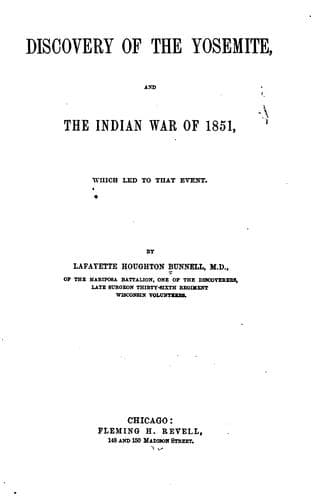
Discovery of the Yosemite, and the Indian War of 1851, Which Led to That EventBunnell, Lafayette Houghton
History
Discovery of the Yosemite, and the Indian War of 1851, Which Led to That Event
Bunnell, Lafayette Houghton
Indians of North America -- California; Pacific Coast Indians, Wars with, 1847-1865; Yosemite Valley (Calif.)
This once turbulent and uncompromising tribe became the most tractable
of the mountain Indians. They were superior in all respects to those of
most other tribes. They had intimate relations with the Monos, a light
colored race as compared with the Valley or Kah-we-ah tribe, and were
very expert in the manufacture and use of the bow and arrow. The Mono’s
had intermarried with the Chow-chil-las, and they aided them in their
intercourse with the Pah-u-tes in their barter for salt, obsidian, lava
and other commodities. The Chow-chil-las now being disposed of, and a
treaty signed by the other tribes, it was decided by the commissioners
that our next expedition should be against the Yo-sem-i-tes. This
had been recommended by Major Savage as the only practical method of
effecting any terms with their old Chief. Every inducement had been
offered them that had been successful with the others; but had been
treated with contempt. The liberal supplies of beef they refused,
saying they preferred horse-flesh. The half-civilized garbs and gaudy
presents tendered at the agency were scorned by Ten-ie-ya as being no
recompense for relinquishing the freedom of his mountain home. Major
Savage announced that the expedition would start as soon as the floods
had somewhat subsided, so that the streams could be crossed. As for
ourselves, we had learned to take advantage of any narrow place in a
stream, and by means of ropes stretched for feet and hands, we crossed
without difficulty streams that we could not ford with horses. As this
delay would allow an opportunity for some of the battalion to see to
such private business as required their attention, short furloughs were
granted to those most anxious to improve this occasion.
While the companies of Captains Boling and Dill were exploring the
vicinities of the Merced and San Joaquin in search of Indians, Captain
Kuykendall, with the able support of his Lieutenants and his company,
were actively engaged in the same duties south of the San Joaquin.
Captain Kuykendall vigorously operated in the valleys, foot-hills and
mountains of the King’s and Kah-we-ah rivers, and those of the smaller
streams south. The Indians of Kern river, owing to the influence of a
mission Chief, “Don-Vincente,” who had a plantation at the Tehon pass,
remained peaceful, and were not disturbed. The success of Captain
Kuykendall’s campaigns enabled the commissioners to make treaties with
all the tribes within the Tulare valley, and those that occupied the
region south of the San Joaquin river.
Owing to lapse of time since these events, and other causes, I am
unable to do justice to him, or the officers and men under him. My
personal recollections of the incidents of his explorations, were
acquired while exchanging stories around camp fires. Operating as they
did, among the most inaccessible mountains in California, with but one
company, they successfully accomplished the duties assigned them.
Public-domain text, read in full here on John Shaqi.
Reviews
Reviews
No reviews yet
Be the first to share your thoughts on this work.
Elsewhere in the archive
Join the Discussion
Join the discussion
Sign in to leave a comment or review.
Sign InorCreate an account