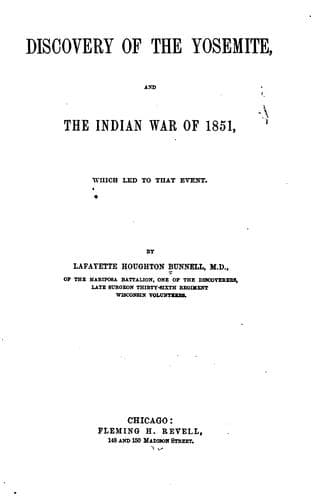
Discovery of the Yosemite, and the Indian War of 1851, Which Led to That EventBunnell, Lafayette Houghton
History
Discovery of the Yosemite, and the Indian War of 1851, Which Led to That Event
Bunnell, Lafayette Houghton
Indians of North America -- California; Pacific Coast Indians, Wars with, 1847-1865; Yosemite Valley (Calif.)
It was supposed that some of the tribes and bands among whom they
were sent were extremely hostile to the whites, and that they would
combine and resist their approach; but after a single engagement on
King’s river, the Indians were put to flight without the loss of a
man, and could not be induced to hazard another like encounter. The
plans of operation were similar to those of Captains Boling and Dill:
the destruction of the camps of all who refused to come in and have a
talk with the commissioners. Captain Kuykendall’s company found these
people almost without fire-arms and civilized clothing of any kind, and
depending wholly on their bows and arrows. Except in the vicinity of
King’s and Kah-we-ah rivers, the savages were scattered over a large
range of country. Their camps were generally in the valleys and among
the foot-hills; when alarmed, they fled to the rocky cañons among the
mountains. In one of our conversations, during a visit of Captain
Kuykendall to the Fresno, he said: “When we first started out, we
learned from our scouts and guides, that a large body of Indians had
collected well up on King’s river. Making a rapid march, we found, on
arriving in sight, that they were inclined to give us battle. We at
once charged into their camp, routed and killed a number, while others
were ridden down and taken prisoners. We followed the fugitives, making
a running fight, until compelled to leave our horses, when they eluded
pursuit. Not yet discouraged, we followed on toward the head waters
of the Kah-we-ah, seeing occasionally, upon a ridge just ahead of us,
groups of Indians; but upon our reaching _that_ locality, they were
resting on the _next ridge_; and as we came into view, turned their
backs upon us, applauding our efforts to overtake them, in a very
_peculiar_ manner. They fled into a worse country than anything before
seen in our explorations, and I soon perceived the folly of attempting
to follow them longer. As to this region east and southeast of the
termination of our pursuit, I have only this to say, that it is simply
indescribable. I did not see any ‘_dead Indians_’ after leaving the
village, and during the pursuit, although some of the boys were sure
they had ‘fetched their man.’ It is certain that a number were killed
in the assault, but how many, we were unable to ascertain, for upon our
return, as usual, the dead had been carried off. We lost no men in the
fight, and had but one wounded. The wound was very painful, having been
inflicted by one of the glass arrow-heads that it is designed shall be
left rankling in the wound; but after that was extracted, the wound
soon healed without serious results.”
Public-domain text, read in full here on John Shaqi.
Reviews
Reviews
No reviews yet
Be the first to share your thoughts on this work.
Elsewhere in the archive
Join the Discussion
Join the discussion
Sign in to leave a comment or review.
Sign InorCreate an account