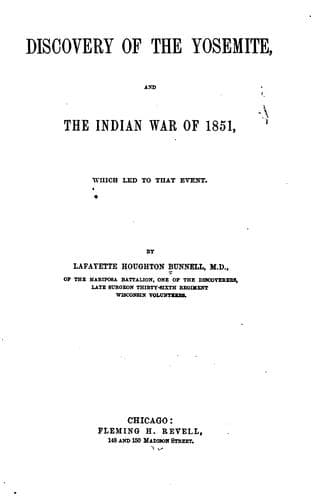
Discovery of the Yosemite, and the Indian War of 1851, Which Led to That EventBunnell, Lafayette Houghton
History
Discovery of the Yosemite, and the Indian War of 1851, Which Led to That Event
Bunnell, Lafayette Houghton
Indians of North America -- California; Pacific Coast Indians, Wars with, 1847-1865; Yosemite Valley (Calif.)
While in camp Sandino had seemed to convey some message to the
hostages, and when asked the purport of it had answered evasively.
This had prejudiced Chandler, but it had not surprised me, nor did it
appear inconsistent with Sandino’s loyalty to Captain Boling; but the
Indian was unpopular. As to his code of honor and his morality, it was
about what should have been expected of one in his position, and as a
frequent interpreter of his interpretations and sayings, I finally told
the Captain and Chandler that it would be best to take Sandino for what
he might be worth; as continued doubt of him could not be disguised,
and would tend to make a knave or fool of him. On one occasion, he was
so alarmed by some cross looks and words given him, that he fell upon
his knees and begged for his life, thinking, as he said afterward, that
he was to be killed.
During the night, and most of the time during the day, I was engaged in
attendance on Spencer. Doctor Black understood it to be Spencer’s wish
that I should treat him. I gave but little attention to other matters,
although I could see from our tent everything that was going on in
camp. Not long after the departure of Chandler and his scouts, as I was
about leaving camp in search of balsam of fir and other medicinals, I
observed one of the guard watching the prisoners with a pleased and
self-satisfied expression. As I glanced toward the Indians I saw that
they were endeavoring to untie each other, and said to two of the
detail as I passed them, “That ought to be reported to the officer of
the guard. They should be separated, and not allowed to tempt their
fate.” I was told that it was “already known to the officers.” I was
then asked if I was on guard duty. The significance of this I was fully
able to interpret, and passed on to the vicinity of “The High Falls.”
On my return an hour afterwards, I noticed when nearing camp, that the
Indians were gone from the tree to which they were tied when I left.
Supposing that they had probably been removed for greater security, I
gave it no further thought until, without any intimation of what had
occurred during my short absence, I saw before me the dead body of old
Ten-ie-ya’s youngest son. The warm blood still oozing from a wound in
his back. He was lying just outside of our camp, within pistol range of
the tree to which he had been tied.
Public-domain text, read in full here on John Shaqi.
Reviews
Reviews
No reviews yet
Be the first to share your thoughts on this work.
Elsewhere in the archive
Join the Discussion
Join the discussion
Sign in to leave a comment or review.
Sign InorCreate an account