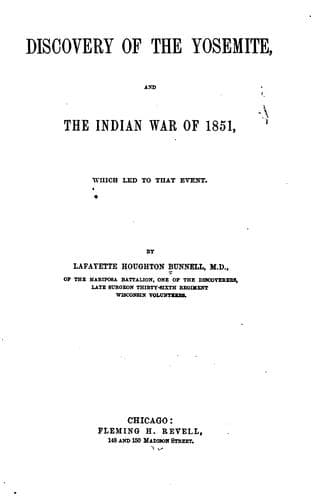
Discovery of the Yosemite, and the Indian War of 1851, Which Led to That EventBunnell, Lafayette Houghton
History
Discovery of the Yosemite, and the Indian War of 1851, Which Led to That Event
Bunnell, Lafayette Houghton
Indians of North America -- California; Pacific Coast Indians, Wars with, 1847-1865; Yosemite Valley (Calif.)
I now comprehended the action of the guard. I learned that the other
Indian had been fired at, but had succeeded in making his escape
over the same ground and into the cañon where the other brave had
disappeared. I found on expressing my unqualified condemnation of
this cowardly act, that I was not the only one to denounce it. It was
a cause of regret to nearly the whole command. Instead of the praise
expected by the guard for the dastardly manner in which the young
Indian was killed, they were told by Captain Boling that they had
committed murder. Sergeant Cameron was no lover of Indians, but for
this act his boiling wrath could hardly find vent, even when aided by
some red hot expressions. I learned, to my extreme mortification, that
no report had been made to any of the officers. The Indians had been
permitted to untie themselves, and an opportunity had been given them
to attempt to escape in order to fire upon them, expecting to kill them
both; and only that a bullet-pouch had been hung upon the muzzle of one
of the guard’s rifles while leaning against a tree (for neither were
on duty at the moment), no doubt both of the captives would have been
killed.
[Illustration: YOSEMITE FALLS.
(2,634 feet in height.)]
Upon investigation, it was found that the fatal shot had been fired
by a young man who had been led by an old Texan sinner to think that
killing Indians or Mexicans was a duty; and surprised at Captain
Boling’s view of his conduct, declared with an injured air, that
he “would not kill another Indian if the woods were full of them.”
Although no punishment was ever inflicted upon the perpetrators of
the act, they were both soon sent to coventry, and feeling their
disgrace, were allowed to do duty with the pack-train. Captain Boling
had, before the occurrence of this incident, decided to establish his
permanent camp on the south side of the Merced. The location selected
was near the bank of the river, in full view of, and nearly opposite,
“The Fall.” This camp was head-quarters during our stay in the valley,
which was extended to a much longer time than we had anticipated. Owing
to several mountain storms, our stay was prolonged over a month. The
bottoms, or meadow land, afforded good grazing for our animals, and we
were there more conveniently reached by our couriers and supply-trains
from the Fresno.
Public-domain text, read in full here on John Shaqi.
Reviews
Reviews
No reviews yet
Be the first to share your thoughts on this work.
Elsewhere in the archive
Join the Discussion
Join the discussion
Sign in to leave a comment or review.
Sign InorCreate an account