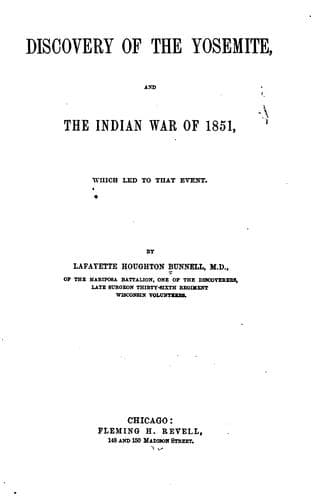
Discovery of the Yosemite, and the Indian War of 1851, Which Led to That EventBunnell, Lafayette Houghton
History
Discovery of the Yosemite, and the Indian War of 1851, Which Led to That Event
Bunnell, Lafayette Houghton
Indians of North America -- California; Pacific Coast Indians, Wars with, 1847-1865; Yosemite Valley (Calif.)
The reports from Savage were considered by the miners and settlers as
absurd. It was generally known that mountain men of Savage’s class
were inclined to adopt the vagaries and superstitions of the Indians
with whom they were associated; and therefore but little attention was
given to the trader’s warnings. It was believed that he had listened
to the blatant palaver of a few vagabond “Digger Indians,” and that
the threatened hostilities were only a quarrel between Savage and
his Indian miners, or with some of his Indian associates. Cassady, a
rival trader, especially scoffed at the idea of danger, and took no
precautions to guard himself or establishment. The settlers of Indian
Gulch and Quartzberg were, however, soon after startled by a report
brought by one of Savage’s men called “Long-haired Brown,” that the
traders’ store on the Fresno had been robbed, and all connected with
it killed except himself. Brown had been warned by an Indian he had
favored, known as Polonio-Arosa, but notwithstanding this aid, he had
to take the chances of a vigorous pursuit.
Brown was a large man of great strength and activity, and as he said,
had dodged their arrows and distanced his pursuers in the race. Close
upon the heels of this report, came a rumor from the miners’ camp on
Mariposa creek, that Savage’s establishment at that place had also been
plundered and burned, and all connected with it killed. This report was
soon after corrected by the appearance of the trader at Quartzberg.
Savage was highly offended at the indifference with which his cautions
had been received at Mariposa, and by the county authorities, then
located at Agua-Fria. He stated that his wives had assured him that a
raid was about to be made on his establishment, and warned him of the
danger of a surprise. He had at once sought aid from personal friends
at Horse Shoe Bend--where he had once traded--to remove or protect
his property. While he was absent, Greeley, Stiffner and Kennedy had
been killed, his property plundered and burned, and his wives carried
off by their own people. These squaws had been importuned to leave
the trader, but had been faithful to his interests. The excitement of
these occurrences had not subsided before news came of the murder of
Cassady and four men near the San Joaquin. Another murderous assault
was soon after reported by an immigrant who arrived at Cassady’s
Bar, on the upper crossing of the San Joaquin. His shattered arm and
panting horse excited the sympathies of the settlers, and aroused the
whole community. The wounded man was provided for, and a party at once
started for the “Four Creeks,” where he had left his comrades fighting
the Indians.
Public-domain text, read in full here on John Shaqi.
Reviews
Reviews
No reviews yet
Be the first to share your thoughts on this work.
Join the Discussion
Join the discussion
Sign in to leave a comment or review.
Sign InorCreate an account