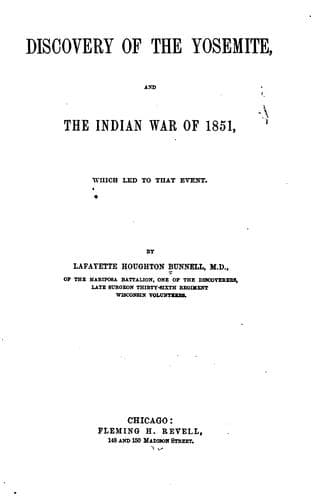
Discovery of the Yosemite, and the Indian War of 1851, Which Led to That EventBunnell, Lafayette Houghton
History
Discovery of the Yosemite, and the Indian War of 1851, Which Led to That Event
Bunnell, Lafayette Houghton
Indians of North America -- California; Pacific Coast Indians, Wars with, 1847-1865; Yosemite Valley (Calif.)
During a hunt in company with Col. Byron Cole, Messrs. Kent, Long and
McBrien of San Francisco, I caught a good sized cub, and Mr. Long, with
a terrier dog, caught another; the mother of which was killed by the
unerring aim of McBrien. These cubs were taken by Cole and McBrien to
San Francisco on their return, and sent to New York. I was told that
they became very tame. I hope they did, for the comfort and security
of their keepers; for in my first efforts to tame a grizzly, I became
somewhat prejudiced against bear training as an occupation. Not long
after my experience, I heard of poor Lola Montez being bitten by one
she was training at Grass Valley for exhibition in Europe; and I now
lost all faith in their reported docility and domestic inclinations.
The California lion, like the wolf, is a coward, and deserves but
little notice. Among the visitors to the Yosemite, some will probably
be interested in knowing where to find the game: fish, birds and
animals, that may yet remain to gratify the sportsmen’s love of the rod
and the chase. Most of the game has been killed or driven off by the
approach of civilization. Deer and occasionally a grizzly, cinnamon or
black bear may be found on the slopes of the Tuolumne, Merced, Fresno
and San Joaquin, and on all the rivers and mountains south of these
streams. The cinnamon bear of California is much larger than the common
brown bear of the Rocky Mountains.
The _blue_ black-tailed deer of California are distinct from the black
tuft-tailed deer of the eastern ranges; a very marked difference will
be observed in their horns and ears. This distinction has been noticed
by naturalists; but the species are often confounded in newspaper
correspondence. The habits of the California deer are more goat-like;
they are wilder, and more easily startled than the “mule-eared” deer
of the Rockies, and when alarmed, they move with the celerity of the
white-tailed Virginia deer. The bare, tuft-tailed and big-eared Rocky
Mountain deer, seem but little alarmed by the report of a gun; and
their curiosity is nearly equal to that of the antelope.
The California deer are still abundant upon the spurs of the Sierras
during their migrations to and from the foot-hills. These migrations
occur during the Autumn and Spring. As the rainy season sets in, they
leave the higher mountains for the foot-hills and plains, keeping
near the snow line, and as the Spring advances, they follow back the
receding snow to the high Sierras and the Eastern Slope, but seldom or
never descend to the plain below. On account of these migratory habits,
they will most likely endure the assaults of the sportsmen. The haunts
of the grizzly are the same as those of the deer, for they alike prefer
the bushy coverts to the more open ground, except when feeding. The
deer prefer as food the foliage of shrubs and weeds to the richest
grasses, and the bear prefers clover, roots, ants and reptiles; but
both fatten principally on acorns, wild rye and wild oats.
Public-domain text, read in full here on John Shaqi.
Reviews
Reviews
No reviews yet
Be the first to share your thoughts on this work.
Elsewhere in the archive
Join the Discussion
Join the discussion
Sign in to leave a comment or review.
Sign InorCreate an account