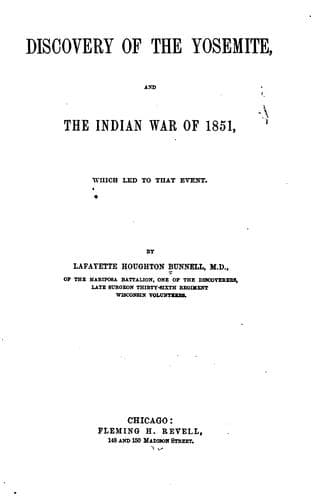
Discovery of the Yosemite, and the Indian War of 1851, Which Led to That EventBunnell, Lafayette Houghton
History
Discovery of the Yosemite, and the Indian War of 1851, Which Led to That Event
Bunnell, Lafayette Houghton
Indians of North America -- California; Pacific Coast Indians, Wars with, 1847-1865; Yosemite Valley (Calif.)
California grouse are found in the vicinity of the Yosemite. During
the months of July and August they were formerly found quite numerous
concealed in the grass and sedges of the valley and the little
Yosemite; but as they are much wilder than the prairie chicken, they
shun the haunts of man, and are now only found numerous in mid-summer
upon or bordering on the mountain meadows and in the timber, among the
pine forests, where they feed upon the pine seeds and mistletoe, which
also afford them ample concealment. Their ventriloquial powers are
such that while gobbling their discordant notes, they are likely to
deceive the most experienced ear. It is almost impossible to feel quite
sure as to which particular tree the grouse is in without seeing it.
He seems to throw his voice about, now to this tree and now to that,
concealing himself the while until the inexperienced hunter is deluded
into the belief that the trees are full of grouse, when probably there
is but one making all the noise. His attention having been diverted,
the hunter is left in doubt from sheer conflicting sounds as to which
particular tree he saw a bird alight in. It is generally pretty sure to
“_fetch the bird_,” if you shoot into the bunch of mistletoe into which
you _supposed_ you saw the grouse alight.
Beside the mountain grouse and mountain quail, among the most beautiful
of birds, that afford the sportsman a diversity of sport, an occasional
flock of pigeons, of much larger size than those of the Atlantic
States, will attract attention; though I have never seen them in very
large flocks. In most of the mountain streams, and their branches,
brook trout are quite abundant. They are not, however, so ravenously
accommodating, as to bite just when they are wanted. I learned from
the Indians that they would bite best in foaming water, when they
were unable to see the angler, or the bait distinctly; their curiosity
stimulating their appetites. It is important that the trout do not see
the angler, and when very wary, the rod even should not be conspicuous.
Below the cañon of the Yosemite, young salmon were once abundant. The
Indians used to catch fish in weirs made of brush and stones; but
during the extensive mining operations on the Merced and other rivers,
the salmon seemed to have almost abandoned their favorite haunts, for
the mud covered spawn would not hatch. Large salmon were speared by the
Indians in all the rivers, with a curious bone spear of but one tine,
while the smaller fry were caught in their weirs. In the Tulare lakes
and in the San Joaquin, King’s, Kern and other rivers, fish, frogs and
turtle are abundant, and water fowl literally swarm during the winter
months in many parts of California.
Public-domain text, read in full here on John Shaqi.
Reviews
Reviews
No reviews yet
Be the first to share your thoughts on this work.
Elsewhere in the archive
Join the Discussion
Join the discussion
Sign in to leave a comment or review.
Sign InorCreate an account