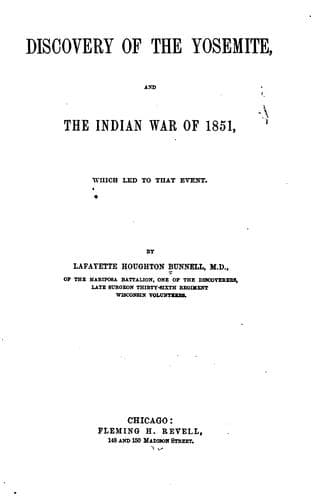
Discovery of the Yosemite, and the Indian War of 1851, Which Led to That EventBunnell, Lafayette Houghton
History
Discovery of the Yosemite, and the Indian War of 1851, Which Led to That Event
Bunnell, Lafayette Houghton
Indians of North America -- California; Pacific Coast Indians, Wars with, 1847-1865; Yosemite Valley (Calif.)
Among the foot-hills of the Sierra Nevada, as well as in all the lesser
mountain ranges, may be found the common California blue quail, and a
very curious brush or chapparel cock, known to the Spanish residents
of California and Mexico as “El Paisano” (The Countryman), and as the
“Correo Camino” (Road-runner), and to ornithologists as the _Geo-coc
cyx Californicus_.[14] They have received the name of “_countryman_”
because of their inclination to run like country children at the sight
of strangers, and that of “road-runner” from the habit of frequenting
roads and trails, for the purpose of wallowing in the dust, and when
alarmed darting off along the road with the speed of an ostrich or wild
turkey. The object they have in wallowing in the dust is like that
of the ruffled grouse, which indulge in the same practice--they sun
themselves and at the same time are rid of vermin. Trusting to their
legs to escape when alarmed, they take the open ground--the road--until
outrunning pursuit they hide in the chapparel, and thus acquire the
name of “road-runner” or “chapparel cock.”
I have never seen any ruffled grouse in the Sierra Nevada, but
a species of these fine birds, are quite abundant in Oregon and
Washington territory. I have been able to solve a question regarding
them, upon which naturalists have disagreed, that is, as to how they
drum. Whether the sound is produced by the wings in concussive blows
upon their bodies, the air, logs or rocks? I am able to say from
personal and careful observation, that the sound of “_drumming_,” is
made, like the sound of the “_night jar_,” exclusively by a peculiar
motion of the wings _in the air_. It is true, the American “pheasant”
or American “partridge,” commonly stands upon a log while drumming, but
I have watched them while perched upon a dry small branch or twig, drum
for hours most sonorously, calling upon their rivals to encounter them,
and their mistresses to come and witness their gallantry. Darwin has
aptly said: “The season of love, is that of battle.” Notwithstanding
the acuteness of observation of Mr. Darwin, he has been led into error
in his statement that wild horses “do not make any danger signals.”
They snort and paw the earth with impatience, when they cannot discover
the cause of their alarm, and almost invariably circle to the leeward
of the object that disturbs them. A mule is the best of sentinels to
alarm a camp on the approach of danger. Deer and elk whistle and strike
the earth perpendicularly with their feet when _jumping up_ to discover
the cause of alarm. Deer and antelope are both so inquisitive, that
if the hunter has not been seen, or has been but imperfectly seen, by
dropping into the grass or brush, and raising some object to view and
suddenly withdrawing it, the deer or antelope will frequently come up
within a few feet of the object. Antelope are especially curious to
know what disturbs them.
Public-domain text, read in full here on John Shaqi.
Reviews
Reviews
No reviews yet
Be the first to share your thoughts on this work.
Elsewhere in the archive
Join the Discussion
Join the discussion
Sign in to leave a comment or review.
Sign InorCreate an account