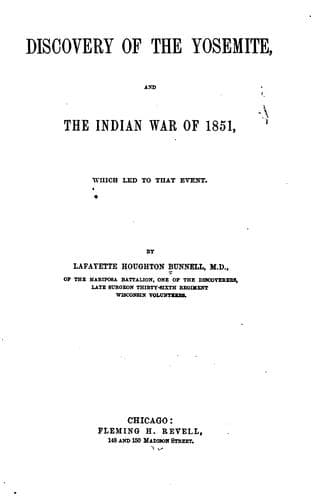
Discovery of the Yosemite, and the Indian War of 1851, Which Led to That EventBunnell, Lafayette Houghton
History
Discovery of the Yosemite, and the Indian War of 1851, Which Led to That Event
Bunnell, Lafayette Houghton
Indians of North America -- California; Pacific Coast Indians, Wars with, 1847-1865; Yosemite Valley (Calif.)
During our long stay in the Yosemite, I discovered that almost every
prominent object and locality in and about it, had some distinctive
appellation. Every peak and cliff, every cañon or ravine, meadow,
stream and waterfall, had a designation by which it could be
distinguished by the Yosemites. I made considerable effort to acquire
these names in their native purity. Although I did not at that time
learn all of them, I did in subsequent visits to the valley and to
the camps of the remnants of the tribes, acquire, as I then believed,
a very nearly correct pronunciation of most of them. I used all the
advantages afforded by my position as one of the Spanish interpreters,
and applied myself perseveringly to the task of preserving these names;
for even at that early day I realized that public interest would, in
time, be attached to that wonderful locality. I was ridiculed for
the idea, or at least for the supposition that it probably would be
awakened during my life-time.
I obtained many of the names of objects and locations from old
Ten-ie-ya himself, whenever I could find him in a communicative mood.
As he was reputed to be quite a linguist, speaking, besides his
native Ah-wah-ne-chee, the Pai-ute, and other dialects, I regarded
his authority as superior to that of either the Po-ho-no or Noot-chü
Indians, who differed from him in the pronunciation of some of the
names.
I was unable to converse with Ten-ie-ya except through an interpreter,
but the words I noted down from the old chief’s lips as they sounded
to my ear at the time, getting the signification as best I could, or
not at all. There is really no more sentiment or refined imagery of
expression among Indians than will be found among ignorant people of
any kind. But living as they do in close affinity with nature, natural
objects first attract their attention, and the dominant characteristics
of any object impress themselves upon their language. Hence many of
their words are supposed to be representative of natural sounds. Our
Po-ho-no-chee and Noot-chü scouts were familiar with the dialect in
common use by the Yosemites, and they also aided me, while at times
they confused, in acquiring the proper names. The territory claimed by
the Po-ho-no-chees, joined that of the Yosemites on the south. During
the Summer months, they occupied the region of the Po-ho-no Meadows,
and the vicinity of the Pohono Lake. Their territory, however, extended
to the right bank of the South Fork of the Merced. It was there we
found a little band on our first expedition. Some of this band were
quite intelligent, having with the Noot-chüs, worked for Major Savage.
It was from them that the Major first learned that the Yosemites were a
composite band, collected from the disaffected of other bands in that
part of California, and what is now Nevada; and as the Major said, the
dialect in common use among them was nearly as much of a mixture as the
Public-domain text, read in full here on John Shaqi.
Reviews
Reviews
No reviews yet
Be the first to share your thoughts on this work.
Elsewhere in the archive
Join the Discussion
Join the discussion
Sign in to leave a comment or review.
Sign InorCreate an account