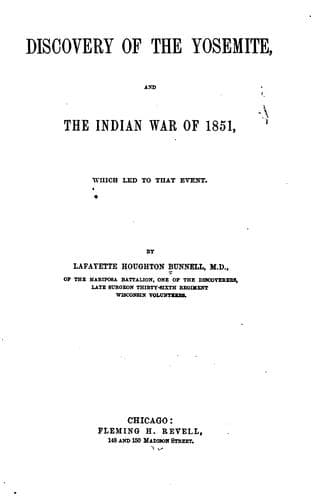
Discovery of the Yosemite, and the Indian War of 1851, Which Led to That EventBunnell, Lafayette Houghton
History
Discovery of the Yosemite, and the Indian War of 1851, Which Led to That Event
Bunnell, Lafayette Houghton
Indians of North America -- California; Pacific Coast Indians, Wars with, 1847-1865; Yosemite Valley (Calif.)
components of the band itself, for he recognized Pai-ute, Kah-we-ah and
Oregon Indian words among them.
Major Savage was intimately familiar with the dialects of his
Indian miners and customers, and was probably at that time the best
interpreter in California of the different mountain dialects.
I consulted him freely as to the pronunciation of the names, and
learned his interpretation of the meaning of them. These names, or most
of them, were first given for publication by myself, as received from
the Yosemites and Po-ho-no-chees; together with English names which had
been given to some of the same points by the battalion. I purposely
avoided all attempts at description, giving instead, a few estimates of
heights. The data then furnished by myself was published in editorials,
and has been mostly preserved, though in an imperfect state, from some
fault in my writing or that of the proof-reader. Reference to old files
of the “California Chronicle,” “Sacramento Union,” “California Farmer”
and the Mariposa papers, will show a somewhat different orthography
from that now in use.[15]
While in the valley I made memoranda of names and important events,
which I have preserved, and which, with interpretations kindly
furnished me by Mr. B. B. Travis, an excellent _modern_ interpreter,
I am now using to verify my recollections and those of my comrades.
While acquiring these names, I employed every opportunity to make
them familiar, but this proved to be a thankless task, or at least
it was an impossible one. The great length of some of the names, and
the varied pronunciations, made the attempt an impracticable one. I
then gave attention to the substitution of suitable English names
in place of the Indian words, and to supersede the fantastic and
absurd ones already suggested and affixed by some of the command. It
is so customary for frontiersmen to give distinctive names of their
own coinage, that we had great difficulty in getting any of the
Indian names adopted; and considerable judgment had to be exercised
in selecting such English names as would “stick”--as would displace
such names as the “Giant’s Pillar,” “Sam Patch’s Falls,” “The Devil’s
Night-Cap,” etc., etc. Many English names were given because they
were thought to be better than the Indian names, which could not be
remembered or pronounced, and the meaning of which was not understood.
The English names agreed upon and adopted at that time have since
been retained, notwithstanding some adverse criticisms and efforts
to supersede them by some fancied Indian or mythological substitute.
Some of these names were the selection of my comrades--“Cloud’s Rest,”
for one; because upon our first visit the party exploring the “Little
Yosemite” turned back and hastened to camp upon seeing the clouds
rapidly settling down to rest upon that mountain, thereby indicating
the snow storm that soon followed.
Public-domain text, read in full here on John Shaqi.
Reviews
Reviews
No reviews yet
Be the first to share your thoughts on this work.
Elsewhere in the archive
Join the Discussion
Join the discussion
Sign in to leave a comment or review.
Sign InorCreate an account